


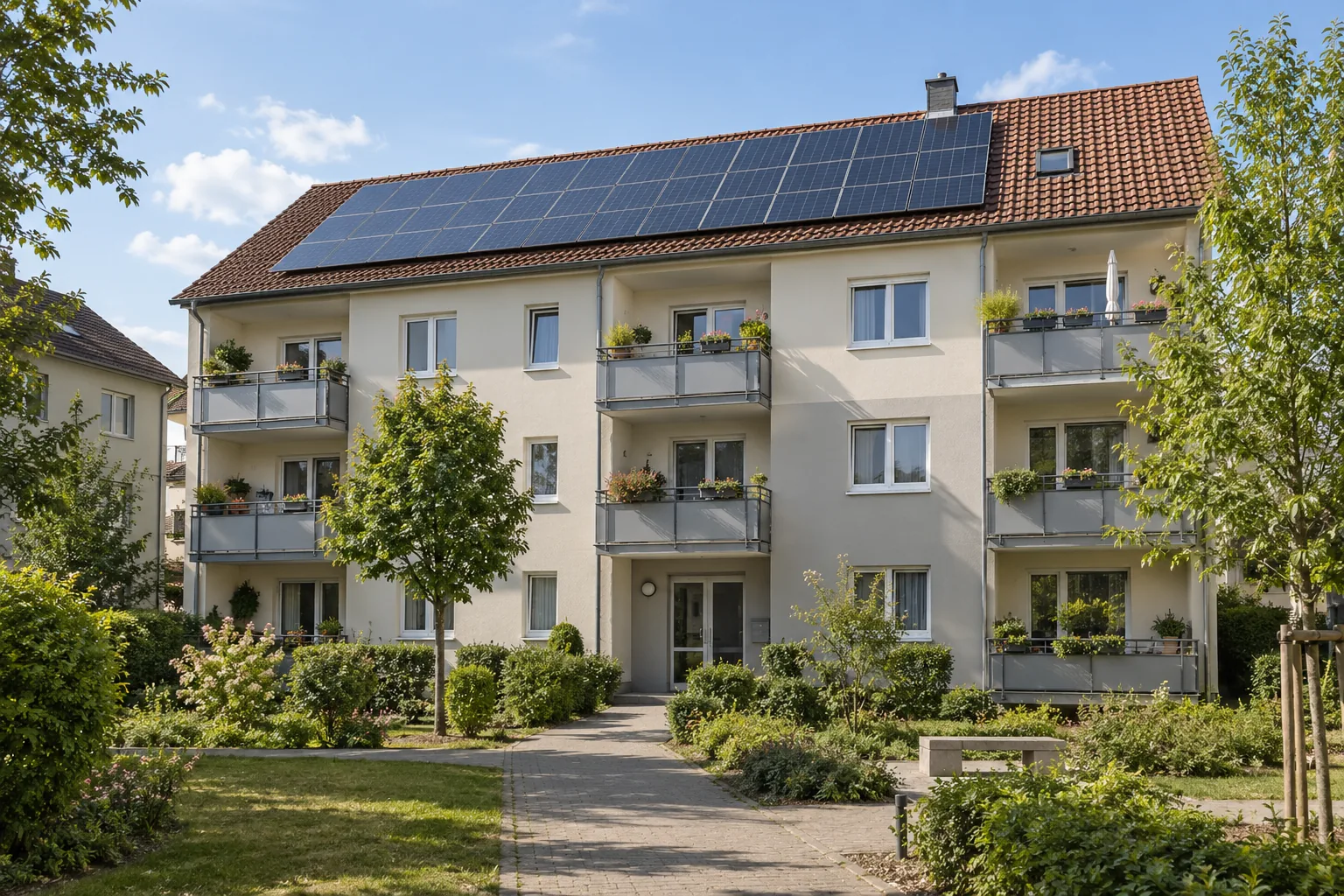
A shared roof · Ulm & region
One roof. Several homes. A shared plan.
Do you rent, own an apartment or let out a building? Find out how solar electricity from a shared roof can be used and what you should agree on together before planning starts.
Your result: a clear comparison of the models and a checklist for discussions with the property manager, owners and specialist planners.
The essentials first
- First, the goal: Should solar electricity supply shared building services, or the apartments too?
- Then, the roles: Agree on system operation, metering, contracts and billing together.
- Next, the offer: Compare benefits and total costs for owners and participating households.
On this page
Where are you starting from?
I rent my home
Ask whether there are already plans for the roof. Explain your interest in solar electricity and request information about participation, contracts and total costs.
First contact: your landlord or the relevant property manager.
I own an apartment
Suggest a joint initial assessment covering the roof, possible uses of the electricity, responsibilities and costs. Collect questions for the owners’ meeting.
First contact: the property manager and interested co-owners.
I let out a building
Clarify your goal and which tasks you want to take on. Compare operating the system yourself with a service provider’s offer.
First contact: independent advice and specialist PV planning.
You do not need a fully planned system or commitments from every household for the first discussion. An initial expression of interest is not an agreement to participate or share costs.
Are you looking for a solution for your own balcony first? Explore plug-in solar →
Who should use the solar electricity?
First decide whether to supply shared building services or individual apartments as well. This determines the contracts, metering and billing arrangements.
Three models for a shared solar roof
Comparing common-area electricity, shared building supply (GGV) and tenant electricity under the EEG.

Model 1
Electricity for shared building services
With common-area electricity the PV system can supply services such as stairwell lighting and the lift. The metering and connection design determines which loads are actually included. This does not yet give individual apartments their own share of solar electricity.
Questions to clarify: Which shared loads operate during the day, who runs the system, and how are costs and benefits allocated?
Model 2
GGV: sharing solar electricity
Under shared building supply (GGV) as defined in Section 42b of the EnWG, solar electricity is allocated within the same building or an associated ancillary structure, without passing through the public grid. Participating households still need their own contract for the remaining electricity and are free to choose that supplier.
Questions to clarify: The allocation key, quarter-hourly metering, price, operation and maintenance. This model does not qualify for the EEG tenant electricity premium.
Model 3
Tenant electricity: a supply offer
Under the EEG tenant electricity model (Mieterstrom) discussed here, the electricity contract covers both solar electricity and the additional grid electricity needed. The supplier organises the full supply. A suitably equipped operator or service provider can take on this role.
Questions to clarify: Who is your contractual partner, what does the full supply cost, and how do billing and moving out work?
What do the different contract rules mean?
Section 42a of the EnWG sets out specific protections for tenant electricity within the meaning of the EEG. For ordinary residential tenancies, the electricity contract is separate from the tenancy agreement. The label “Mieterstrom” alone does not tell you whether an offer falls under this model. Ask for the model to be named explicitly.
GGV generally requires a building electricity use agreement. Section 42b(6) provides a specific option based on an owners’ association resolution for a system operated by that association. The detailed arrangements and individual users’ rights must still be taken into account.
What if nobody wants to bill apartments for electricity?
A system that exports all its electricity is another option. The apartments then retain their normal electricity supply. Compare export revenue with investment and operating costs, as well as the other possible uses of the roof.
Further reading: EnWG: Section 42b building supply and Section 42c shared use · Section 42a EnWG: tenant electricity contracts · Federal Network Agency: tenant electricity for consumers · Federal Network Agency: solar on multi-unit buildings
Put a name to each responsibility.
One company can perform several roles. Even so, the offer should clearly state who is responsible for what.
- Owners and property management: prepare roof use, coordination, commissioning and financing.
- System operator: organise PV system operation, maintenance and fault handling.
- Electricity supplier or billing service: manage the contracts and bills required by the model; under GGV, the remaining supply stays separate.
- Electrical contractor, grid operator and metering operator: coordinate the connection, metering design, readings and their respective implementation tasks.
For owners’ associations: discuss the system and participation separately
One discussion concerns roof use, installation, financing and system operation. Another concerns which households receive electricity and on what terms. Interest in the roof project does not itself create an individual electricity agreement.
Where privately owned apartments are rented out, the owner and the electricity user are often different people. Record who is expected to invest and who will actually receive the electricity. Have the resolutions, cost allocation and contracts needed for your owners’ association reviewed.
A question for a service provider: Which tasks remain with us, and what is actually included in the annual price?
Further reading: EnWG: Section 42b building supply and Section 42c shared use · BSW/GdW: building supply guide (2024 edition, PDF)
A real-life experience · co2online
Tenant electricity: organisation matters too
Jan explains how he provides solar electricity for his tenants. Alongside the technology, he describes the work involved in billing and coordinating with the organisations concerned.
The report describes his tenant electricity project. Tasks and contracts differ according to the supply model chosen.
Read the experience report on co2online (external)
Prepare a discussion about your own roof project
Report: 15 May 2025 · Link and context checked: 29 September 2026.
Documented project in Ulm
One solar roof supplies 32 households.
123.84 kWpPV capacity
288solar panels
32households supplied
Energiepark Ulm documents a tenant electricity system on an apartment building in Ulm. These three figures come from the installer’s project description.
What can you take into your own planning? Alongside a suitable roof, the project needs a clear supply and metering setup. Ask early who handles operation, billing and changes in participating households.
Which figures are missing for a cost comparison?
Investment cost, the electricity tariff, measured self-consumption and longer-term operating results are not specified on the linked project page. This illustrates a local implementation; it is not a financial assessment or supplier recommendation.
Plan the roof and electricity meters together.
Assess the building
- Gather information on roof condition, shading and upcoming roof work.
- Have structural suitability, cable routes and available equipment space checked on site.
- Include existing PV, central heating and future charging points.
Clarify the metering
- Which meters and metering points are already present?
- Which readings does the chosen model need, and who processes them?
- Which alterations, recurring charges and deadlines are involved?
For GGV, an annual reading is not enough to allocate electricity: quarter-hourly values are required.
Before placing a binding order: Have the specific metering and billing design coordinated with the organisations involved. Ask about the planned supply start date and which requirements still need to be met. A model being legally possible does not confirm a start date for your building.
Further reading: EnWG: Section 42b building supply and Section 42c shared use · Ulm Netze: generation systems and storage
How is the electricity allocated?
An allocation key assigns measured amounts of electricity. It is not a promise that solar will meet half of every household’s demand at all times.
Illustrative example: Two participating apartments, one quarter-hour, no battery. There are 2.0 kWh of solar electricity available during this period. A fixed 50:50 split has been agreed, with no redistribution of unused shares.
2.0 kWh of solar electricity in a quarter-hour
Two participating apartments, no battery: a fixed 50:50 allocation key with no redistribution of unused shares.

Calculation values as a table
| Apartment | Consumption | PV share | Grid imports |
|---|---|---|---|
| A | 1.4 kWh | 1.0 kWh | 0.4 kWh |
| B | 0.6 kWh | 0.6 kWh | 0.0 kWh |
| Total | 2.0 kWh | 1.6 kWh | 0.4 kWh |
Apartment A
Consumption: 1.4 kWh
Solar electricity share: 1.0 kWh
Additional grid imports: 0.4 kWh
Apartment B
Consumption: 0.6 kWh
Solar electricity share: 0.6 kWh
Additional grid imports: 0.0 kWh
Of the 2.0 kWh, 1.6 kWh is therefore allocated to the apartments. In this simplified example, the remaining 0.4 kWh goes to the grid. Under the chosen key, it is not additionally allocated to apartment A.
Why do the key and consumption times matter?
Other agreed keys can distribute unused shares differently. Allocation is limited by the available amount and actual consumption in the same time interval. This example explains a fixed key only; it does not assess a particular system or annual savings.
Ask for a sample bill and an explanation of how the key is adjusted when participants join or leave. A share of the investment costs and a share of the electricity used are different quantities.
Further reading: EnWG: Section 42b building supply and Section 42c shared use · BSW/GdW: building supply guide (2024 edition, PDF)
Who pays for what?
Assess the system’s economics and a participating household’s electricity costs separately. A low price per kilowatt-hour does not describe the whole offer.
For the owners
- Have the PV system, planning and roof work itemised separately.
- Include the meter cabinet, wiring and commissioning.
- Account for maintenance, insurance, metering, administration and billing.
- Make revenue, financing and participation assumptions explicit.
For the household
- Compare the solar electricity price and any standing or service charges.
- For GGV, also include your own supplemental electricity tariff and its standing charge.
- Count only solar electricity that can be transparently allocated to you.
- Clarify price changes, contract term and switching costs.
To compare two offers: use the same system, consumption assumptions and time period. Also ask what happens if fewer apartments participate or recurring charges rise.
How should I account for financial support?
Ask which support applies to the offered model and planned commissioning date, and who receives it. A tenant electricity premium is not an automatic payment to tenants. Treat unconfirmed support as a separate scenario and check eligibility before placing an order.
Explore programmes, the status of Ulm funding and the right steps →
Use the shared cost and quote template →
Further reading: Federal Network Agency: tenant electricity for consumers · Federal Network Agency: solar on multi-unit buildings
Move forward in six steps
- Record the goal: shared building electricity, apartment electricity or grid exports? One person coordinates the initial assessment.
- Gather interest and baseline information: record the apartments, roof, known consumption and planned work. Mark missing information as still open.
- Compare models and roles: request offers for operation, supply and billing on the same basis.
- Clarify feasibility and metering: review the building, connection, data processes and costs with specialist planners and the relevant operators.
- Make decisions and agreements: prepare the necessary resolutions, financing, use arrangements and contracts, with named responsibilities.
- Implement and start together: coordinate installation, notifications, registration, metering and handover; explain the first bill and points of contact.
After each step, agree on a specific outcome and the next date. A list of interested people does not replace specialist planning or a legal review of contracts and resolutions.
Think about day-to-day operation too.
Moving in, moving out and new participants
Clarify who reports changes, how participation and billing start or end, and how vacancies are handled. Include deadlines, meter readings, responsibility for the final bill and adjustments to the allocation.
Faults and later changes
Record who receives fault reports, resolves metering errors and informs users. Ask how a change of operator, roof work or the end of a service contract would be handled.
Consider heat pumps, charging points and batteries
These loads change demand and consumption times. Define which metering point they belong to and how electricity amounts and costs are allocated. A battery needs its own transparent assessment of additional benefits; it does not automatically follow from a shared roof project.
Plan several projects together → · Prepare shared charging infrastructure → · Compare battery storage →
Is this the same as energy sharing?
No. Section 42c of the EnWG describes shared use involving electricity passing through the public grid. GGV under Section 42b, as explained here, stays within the building or an associated ancillary structure without that grid transit. A project spanning several buildings or grid connections therefore needs a separate assessment of the appropriate model.
Further reading: EnWG: Section 42b building supply and Section 42c shared use
Seven details for the first discussion
For an initial contact, your interest in the shared roof and a request for the right contact person are enough. You do not need to have chosen a model or collected the following seven details first. Add only what you already know to your notes. “Still open” is a useful answer. Personal consumption data from other households is not needed for this first discussion.
- Our building: address, number of apartments, rented/owners’ association/other ownership structure; responsible property manager: …
- Our goal: common-area electricity, apartment electricity or grid exports; intended benefit: …
- Known starting point: roof, existing system, meters and planned roof or heating work: …
- Interest and roles: responses so far; who coordinates, who could operate the system and handle billing: …
- Models to compare: GGV, EEG tenant electricity or another option; open questions about contracts and metering: …
- Cost questions: budget, one-off and recurring items, allocation of investment and benefits: …
- Next step: which information or document is missing, who will obtain it, by when, and with whom will we discuss the result: …
An example of an initial enquiry
“In our building with eight apartments, we would like to explore using solar electricity from the shared roof. There is interest, but no participation agreements yet. We would like to compare GGV with a tenant electricity offer. Which documents do you need, who clarifies metering and billing, and what costs arise during the initial assessment?”
This is an illustrative conversation example. Add only details that actually apply to your building.
My next step
- What I know: I want to use solar electricity from the shared roof; I have noted my role and the building details I know.
- What is still open: Are there existing plans or a designated contact? The model, costs and participation may still be undecided.
- Who can help: As a tenant, I first ask the landlord or relevant property manager. As an apartment owner, I involve the property manager and owners’ association.
- What I will do next: I explain my interest, ask about existing plans and agree on who will obtain the next piece of information and by when.
Find the right support in Ulm
For an initial assessment: The Regional Energy Agency Ulm offers access to building energy advice. Describe your shared roof project and ask which advice service or specialist contact would be suitable.
For the connection and metering design: the relevant grid operator must be involved for the local network area. The information from Ulm Netze on generation systems and storage is a local starting point. Ask specifically about your intended model; this does not yet confirm that it can be implemented in your building.
For implementation: specialist PV planners, the metering operator and, where needed, a supply or billing service require a shared definition of tasks. Have resolutions and contracts reviewed for your ownership and usage structure.
Any questions left?
Do all apartments have to participate?
Participation in the electricity model and financing the rooftop system must be clarified separately. First establish interest and ask what level of participation the offer assumes. Any required association resolutions and their cost implications must be reviewed independently for your owners’ association.
Can I keep my electricity supplier under GGV?
You remain free to choose the supplier for supplemental grid electricity. Whether your existing contract and billing can continue unchanged must be clarified through the specific metering and supply process. Do not cancel your current contract pre-emptively.
Further reading: EnWG: Section 42b building supply and Section 42c shared use
Am I guaranteed a lower electricity price?
The model’s name alone cannot tell you that. Compare the total annual cost, including fixed charges, supplemental electricity and a realistic solar allocation. Where values are uncertain, use several scenarios instead of a seemingly precise savings figure.
Can the electricity simply be included in service charges?
Electricity for individual apartments under a tenant electricity model must be distinguished from shared building operating costs. Supplying apartments requires the appropriate electricity contracts and billing. Ask for common-area and apartment electricity to be explained separately in the offer.
Further reading: Federal Network Agency: tenant electricity for consumers
Sources, date and limitations
Editorial status: 19 September 2026. This page supports orientation and preparation. The specific metering design, economic assessment, resolutions and contract documents must be reviewed for each building.
- EnWG: Section 42b building supply and Section 42c shared use
- Section 42a EnWG: tenant electricity contracts
- Federal Network Agency: tenant electricity for consumers
- Federal Network Agency: solar on multi-unit buildings
- BSW/GdW: building supply guide (2024 edition, PDF)
- Regional Energy Agency Ulm: building energy advice
- Ulm Netze: generation systems and storage
The EnWG was checked in its current consolidated version. The BSW/GdW guide is identified as the 2024 edition; its statements at that time about practical market processes do not confirm availability in Ulm in 2026. The allocation example is illustrative and is not an annual forecast.