



Solar PV / Rules & meters
Solar peak rules & smart meters: what applies to my PV system?
Metering, control and remuneration are linked. The commissioning date, system capacity and equipment are decisive. This page provides guidance for rooftop PV from 2 kW to below 100 kW with statutory feed-in remuneration. Additional rules apply to other arrangements.
Understand the equipment · Check smart meter requirements · Understand solar peak rules · Prepare for a discussion
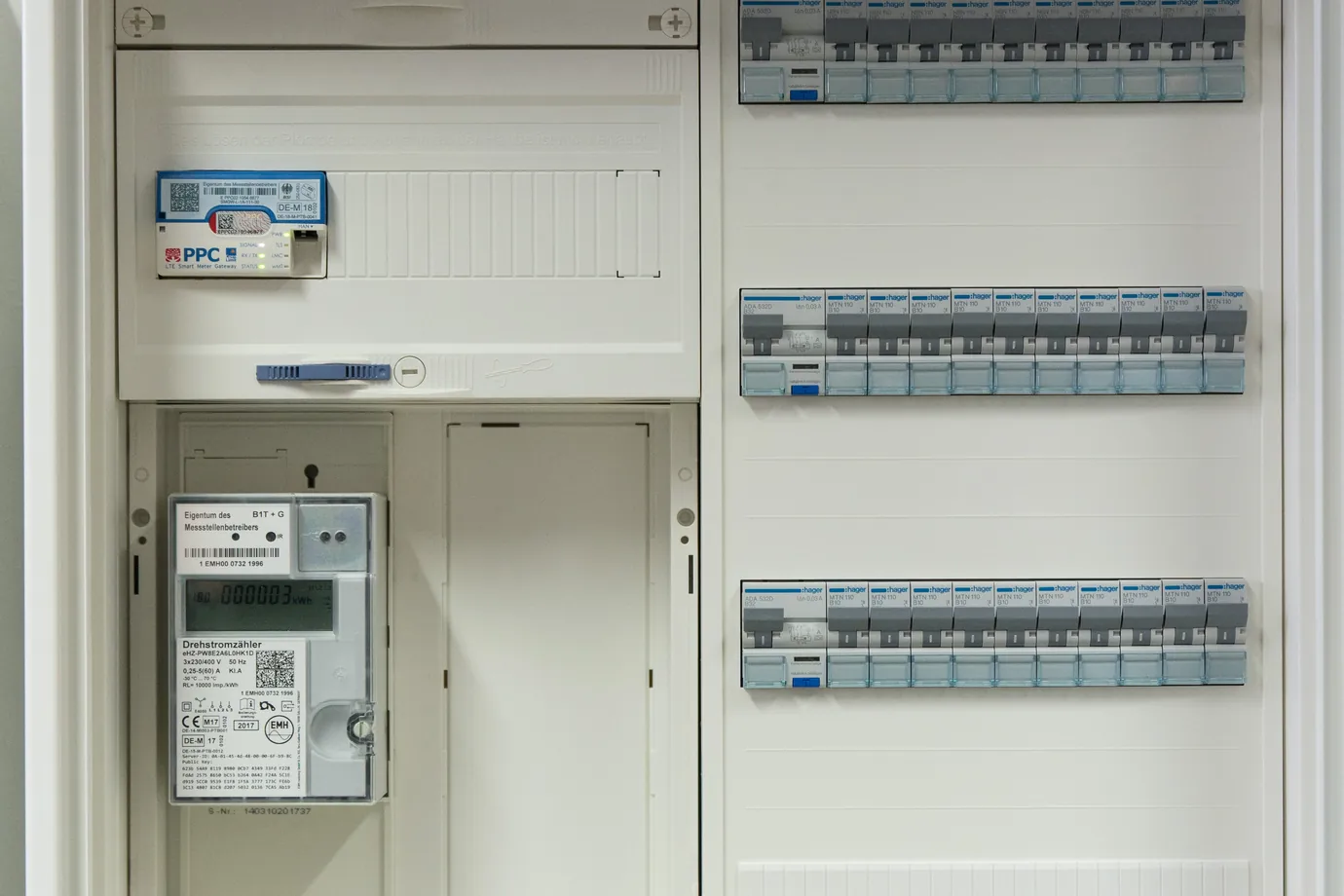

Three terms, three functions.
Metering, communication and control
A smart metering system combines a meter and a gateway. Control requires an additional function.

Digital meter
The modern metering device (mME) measures digitally. On its own, it is not yet a smart metering system.
Smart meter
The smart metering system (iMSys) combines a digital meter and a smart meter gateway.
Control device
Often called a “control box”, this equipment implements control signals. The iMSys and the control device are separate components; replacing the meter alone does not confirm that control is operational.
Who is covered by the mandatory rollout?
Section 29 MsbG lists the following cases in particular:
- Annual electricity consumption above 6,000 kWh: installation of an iMSys; the average of the last three recorded annual values generally determines this.
- PV with installed capacity above 7 kW: an iMSys and, in principle, a control device as part of the statutory rollout.
- An agreement under Section 14a EnWG: an iMSys and a control device for the covered appliances.
The thresholds are above 6,000 kWh and 7 kW respectively. Installation is also possible below these thresholds, voluntarily or at the metering operator’s discretion.
A mandatory case does not mean an immediate installation date. The default metering operator must meet statutory rollout quotas under Section 45 MsbG. Clarify timing, annual charges, control equipment and any work needed on the meter cabinet. Existing systems may also fall within the rollout.
Legal basis: Section 29 MsbG · Section 45 MsbG · Federal Network Agency: meters, installation and costs
Two changes for new systems.
The legislation commonly known as the Solarspitzengesetz entered into force on 25 February 2025. For systems commissioned on or after that date, two separate questions matter:
1 · How much power may be exported to the grid?
New PV systems below 100 kW receiving feed-in remuneration or the tenant electricity premium are temporarily limited to 60% of installed capacity at the grid connection point. From 25 kW to below 100 kW, remote controllability by the grid operator is also required. The limit ends only after installation of an iMSys and a control device and a successful controllability test by the grid operator.
2 · When is exported electricity remunerated?
When spot market prices are negative, the applicable value under Section 51 EEG falls to zero. EEG remuneration for exports is not paid for those periods. For the new systems below 100 kW considered here, this applies from the calendar year after the iMSys is installed. Example: installation in 2026 ? application from 1 January 2027. The 60% limit and the start of zero remuneration therefore have different conditions.
A 60% power limit does not mean 40% less annual generation. For a 10 kWp system, export power is limited to 6 kW. Simultaneous self-consumption and suitable storage can absorb peaks. The effect depends on the roof, consumption and system operation.
Section 51a EEG extends the remuneration period using a specific calculation. This is not an immediate refund of lost revenue and does not guarantee full financial compensation.
Legal basis: Section 9 EEG · Section 51 EEG · Section 51a EEG
Common questions
Does this also apply to my older system?
The new remuneration rules do not apply retrospectively across the board. Transitional provisions cover systems commissioned before 25 February 2025; earlier technical and remuneration requirements may continue to apply. The effects of extensions or a voluntary switch to the new rules need separate assessment. Section 100 EEG: transitional provisions
What about balcony solar?
Plug-in solar units with a combined maximum of 2 kW of module capacity and 800 VA of inverter output behind one point of electricity supply are exempt from the 60% requirement described here. They form a separate use case. Go to the plug-in solar guide
Is this the same control as under Section 14a EnWG?
The rules concern different directions of electricity flow: Section 9 EEG concerns exports, while Section 14a EnWG concerns grid imports by covered home chargers, heat pumps or batteries. Both sides may be relevant to a battery. Understand controllable appliances
Take these four points into your discussion.
- Establish your situation: collect the commissioning date, installed capacity, remuneration arrangement and details of existing metering equipment.
- Installer: clarify implementation of the export limit, interfaces and any meter cabinet work in writing.
- Metering operator: ask about the installation date, control device and recurring costs.
- Grid operator: coordinate the controllability test and documented removal of the export limit.
In the Ulm Netze area: connecting generation systems and storage. For your quote: compare PV quotes systematically.
Sources checked: 28 September 2026. The legislation linked above and the Federal Network Agency’s explanations are authoritative. Clarify how your specific system is classified with the installer, grid operator and metering operator.