



Charging in Ulm & on the move
Drive electric. Even without a home charger.
Would public charging fit into your everyday life? What matters is finding accessible charging locations, suitable time windows and clear costs. Build your own charging plan here.
Calculate charging needs · Understand the costs · Compare charging tariffs · Prepare for your first charge

Key points at a glance
- Fit charging into your routine: Look for charging points where your car already stays for a while. Compare your charging needs with the time available.
- Find two suitable locations: Check connectors, access and opening hours. Plan a backup for occupied or unavailable charging points.
- Check the full price: Confirm the tariff for your app, card or direct payment, including any time-based, session and parking charges.
- Try it in practice: Test a typical charging session and note the time needed, energy delivered and total cost.
01 · Start with your week
Where is your car parked anyway?
Near home
Look for places that fit your evening or weekend routine. Consider the walk back and when you can move your car after charging.
At work
Ask about eligibility, access hours, reservations and billing. Plan a second option for days off or when the charging point is occupied.
While running errands
Check charging options at places you visit regularly. Compare the time you spend there with your charging needs and the permitted parking time.
Start by noting the distance you drive between two planned charging sessions. Consider occasional longer trips separately; these need charging stops along the route and at your destination.
02 · Search locally
Two starting points for your search.
Search across operators
The Federal Network Agency’s charging map helps you search your chosen area. It includes registered charging installations and is incomplete. Then check current availability, access and prices with the provider.
Check the local offer
SWU map and charging information →
SWU provides access to a map, information about its LadeStrom card and charging without an ongoing charging-card contract. Check the price for your chosen payment method at the specific charging point.
Three examples in central Ulm
The following car parks list charging stations among their facilities. They are starting points for your search; other locations may suit you better depending on where you live and work.
Am Bahnhof
Right by the main railway station. Check whether this location fits your regular journeys.
Am Rathaus
In the city centre on Neue Straße. Also check the operator’s current closure notices.
Fischerviertel
On Schwilmengasse, with access via Neue Straße. Check the walking route to your actual destination.
Before setting off: Available parking spaces do not necessarily mean available charging points. Check charging-point status, current operator notices and signs on site. These examples are not a complete list.
636 registered public charging points in the Ulm urban district
As of 30 September 2026, the Federal Network Agency’s register lists 636 charging points across 341 charging installations as “In operation” in the Ulm urban district. Several installations may share a location, so the number of installations is not the number of locations.
Method: district/independent city = “Stadtkreis Ulm”, status = “In Betrieb”, sum of the “Anzahl Ladepunkte” field. This also includes entries listed under neighbourhood names; Neu-Ulm is excluded. Source: Bundesnetzagentur.de · register download (30.09.2026), CC BY 4.0 licence.
The register is incomplete. The figure covers neither private home chargers nor currently available charging spaces. Check access, availability and prices at the specific charging location.
Public charging points in Ulm over time
The statistical register records 84 reported public charging points in 2017 and 642 in 2026. Every year uses the same reference date: 1 July.
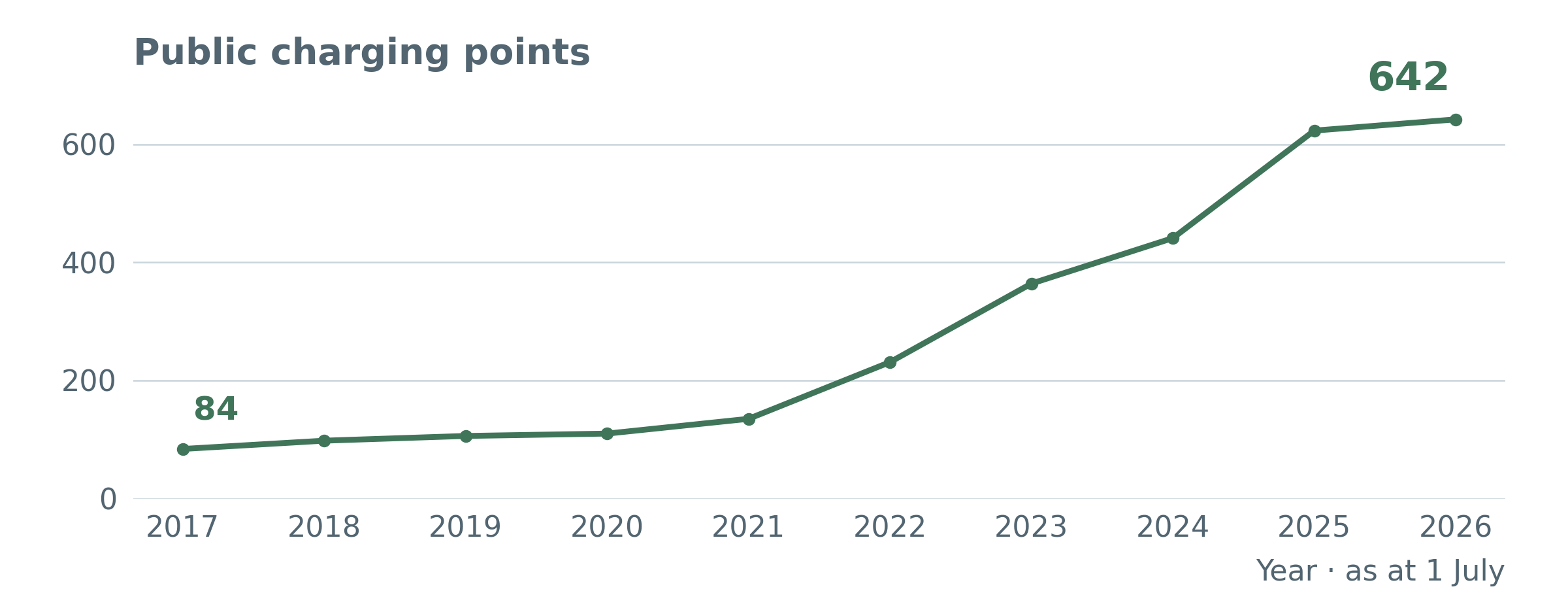
Annual values, sources and scope
| Year | Total charging points |
|---|---|
| 2017 | 84 |
| 2018 | 98 |
| 2019 | 106 |
| 2020 | 110 |
| 2021 | 135 |
| 2022 | 231 |
| 2023 | 364 |
| 2024 | 441 |
| 2025 | 623 |
| 2026 | 642 |
Source: Bundesnetzagentur · Ladeinfrastruktur in Zahlen, workbook dated 1 September 2026, sheet “4.3 Ladepunkte je Kreis”, row “Stadtkreis Ulm”. Values combine normal and fast charging points; they are not counts of charging stations and do not include private wallboxes.
All ten annual observations are documented. Normal and fast charging points add up to the reported total at every selected date. The series consistently uses 1 July; the internally inconsistent January 2025 observation is excluded. Later notifications may revise historical register values. Checked on 30 October 2026.
Why does the last value differ from the figure above? This series comes from a statistical register that also includes notifications still being processed. The location list quoted above uses a different selection. The two figures are therefore not directly comparable.
03 · Estimate the time needed
Enter the distance you want to cover before your next charge. Use a realistic average charging power for your vehicle and location; the station’s advertised maximum power is not automatically suitable for this calculation.
Your journeys · Your charging window
Is there enough time to charge?
Estimate how much electricity your journeys require and how long recharging takes at an assumed average charging power.
Electricity required
– kWh
Calculated charging time
–
Please enter your values.
How the calculation works
Electricity required = distance × consumption per 100 km ÷ 100. Charging time = electricity required ÷ average power at the charge point. Energy available in the window = average power × available hours. The comparison uses unrounded values; times are rounded up to whole minutes.
At zero kilometres, these journeys require no recharging. At zero power, no energy can be charged. Zero electricity consumption is not a meaningful assumption for this comparison.
What the result means
The result applies to the distance entered and the assumed average charging power. It describes neither a full battery charge nor a charging curve. The vehicle, temperature, battery level, power limits and charging pauses can change the actual time. Allow some extra time.
Consumption and power refer to electricity at the charge point. Charging losses are already included in consumption and are not added again. Consumption shown by the car may not include charging losses.
This calculator does not design an electrical installation or grant connection approval. Ask your installer whether the assumed power is available at your location.
This calculator does not transmit or store your inputs. Calculations run in your browser.
How can I use the result for public charging?
Start with a regular charging location. If the time window is too short, compare a longer window, more frequent stops or another suitable location. Allow extra time for getting there, starting the session and moving your car afterwards.
The model uses an assumed average power. It does not represent an individual fast-charging curve. Do not treat a high peak power as continuously available. SWU: charging power limits
04 · Build your charging plan
A regular location. A workable alternative.
Compare two or three specific locations. Record your answers in a note on your phone, for example. The key is whether each location works at the times you actually need it.
What to note for each location
- Travel and time: detour, walking distance, opening hours and usual length of stay.
- Charging point: compatible connector, required cable and realistic charging power.
- Access: who may use it, app, card or available direct-payment option.
- Total price: energy price, other charges and parking costs.
- On site: signs, permitted parking time and options for moving your car.
- Alternative: the next suitable location if charging is unavailable.
How to check your plan
Location A: This is where I normally want to charge. The time window covers my usual journeys.
Location B: I can use this location when A is occupied or out of service. I have also checked access and payment.
Optional location C: An additional option for other days of the week or longer trips.
Try a typical charging session before relying on it in everyday life. A location on a map alone does not establish a reliable charging plan.
05 · Look at the full price
What does a charging session really cost?
Before starting, check which tariff applies through your app, card or direct payment. The same charging point may charge different rates depending on how you access it. Example: SWU price components
- Energy: kilowatt-hours charged × price per kilowatt-hour.
- Monthly fees: for an account, card or tariff, for example; these may apply even if you do not charge.
- Session fee: a possible fee for each charging session.
- Time-based charges: for example, after a certain connection time. Check when charges start, billing intervals and any cap in the tariff.
- Parking: allow for extra parking fees and the permitted parking time at the location.
A simple worked example
24 kWh × €0.50/kWh gives €12 for energy. With a €2 parking fee, this visit costs €14, provided no other charges apply.
Freely chosen example values, not a current tariff offer. When comparing several charging sessions, any monthly fee must also be included.
Use the calculator below to compare two public charging tariffs, including recurring extra charges. A separate calculator compares energy-only charging costs at home and in public.
Your cost comparison
Have the pricing terms for both tariffs ready. Use the same example month and the same charging sessions. Also check whether both tariffs apply at your charging locations.
Public charging · compare tariffs
What does a month of charging cost?
Compare two tariffs you enter for the same charging sessions. Energy, standing fees and additional costs are shown separately.
The initial values are freely chosen examples, not current tariff offers. Enter gross prices from the terms for the charging point and access method you actually use.
Please enter your usage profile.
Tariff A
Monthly costs
– € / month
- Fixed fees
- –
- Energy
- –
- Session fees
- –
- Time-based charges
- –
- Parking costs
- –
–
–
Tariff B
Monthly costs
– € / month
- Fixed fees
- –
- Energy
- –
- Session fees
- –
- Time-based charges
- –
- Parking costs
- –
–
–
Please check all cost items.
How the calculation works
Monthly costs = fixed monthly fees + number of sessions × (energy per session × energy price + session fee + time-based charge + parking costs). Unknown items are excluded and the amount is then marked as a subtotal. One-off costs are shown separately.
The automatic time rule uses: chargeable minutes = the greater of 0 and connection time minus free minutes. These minutes are rounded up to whole billing intervals and multiplied by the price per minute. Any per-session cap is then applied. With zero sessions, fixed monthly fees remain; an effective price per kWh is shown only when energy is positive and recurring costs are complete.
Calculations use unrounded values; the display is rounded to cents. Different invoice rounding rules may cause small differences.
What the comparison covers
The calculator compares the cost assumptions entered. It does not know current offers, tariff availability or contract durations. Consumption, charging speed, connection time and parking time are not automatically derived from one another. Free allowances apply per session, not once for the whole month.
For multiple time bands, free periods, charges starting after charging ends or combined discounts, enter an amount you calculate yourself if it can be determined reliably. Otherwise select “Still unknown”. Check costs outside this model separately; the calculator does not identify a definitive cheapest offer.
Calculations run in your browser. Entries are not sent to the website. Only when you choose “Add to my plan” is a snapshot kept in this browser tab. You can export or clear it in the planning sheet.
06 · Try it in practice
Start with a manageable first attempt.
Four steps for your first charging session
From preparation to checking the bill.

The four steps in detail
- Prepare: choose a charging location and a backup, check access and payment, and allow enough time.
- Check on site: check the connector, signs, price and any time-based charges. Have the correct cable ready if you need to bring your own.
- Start charging: follow the instructions at the charging point or in the app, and check that the vehicle and charging point confirm the session has started.
- Finish and review: stop the session correctly, stow the cable, free up the space and check the bill. Note the time needed, energy charged and total cost.
If charging does not start, use the operator’s listed support service or your backup location. For your first attempt, choose a time when you will not need to rush to another appointment afterwards. SWU: public charging support
Key terms explained briefly.
What is the difference between AC and DC charging?
AC stands for alternating current: the vehicle converts it into direct current for the battery. With DC charging, the charging station performs this conversion. DC is often used for fast charging. Connector compatibility and charging power also depend on the vehicle. AC explained · DC explained
Why does my car not charge at the stated maximum power?
The station’s rating describes a possible maximum power. The vehicle and cable can limit it, and it can vary during a session. For planning your time, the achievable average power is what matters. SWU: understanding charging power
What is the difference between kW and kWh?
Kilowatts (kW) measure power. Kilowatt-hours (kWh) measure an amount of energy. At a constant 7 kW, the calculated energy supplied at the charging point over two hours is 14 kWh. The cost depends on the billed energy and any other charges.
How do I plan longer trips?
Add suitable charging locations along your route and at your destination to your everyday plan. Check vehicle connectors, access and opening hours, and identify a backup. Allow for travel to the charging point and possible waiting time as well as charging time.
Your next step
Choose two locations and try one.
Combine your calculated charging needs with two suitable locations. Check the costs for the way you will actually access them and try a charging session. You can then better judge how well public charging fits into your week.
Could you use an allocated parking space after all? Read the guide for tenants and owners’ associations.
Sources and editorial status
- Federal Network Agency: charging map and register limitations
- SWU: LadeStrom card, direct charging and price components
- Parken in Ulm: Am Bahnhof
- Parken in Ulm: Am Rathaus
- Parken in Ulm: Fischerviertel
- SWU: questions about access, billing and the charging process
- SWU: AC charging · DC charging · Charging power
Sources checked on 17 September 2026. Recheck prices, access and operator notices before use. The locations are examples. Formulas and model limitations are explained alongside the calculators.