



Existing house · Your heating route
Your next heating system starts with the right questions.
Which heat supply suits your existing house? Assess heat pumps and district heating using your building, a reliable timetable and complete quotes.
Go to Heat pump · District heating · Understand electricity demand · Costs and financial support.
Key points at a glance
- Start with your building: Gather consumption records, heating details and planned renovation work. Establish when the new heating system needs to be ready.
- Check both options: Have a specialist assess heat pump suitability and confirm district heating availability for your address.
- Compare complete quotes: Consider installation, necessary alterations and running costs using the same assumptions. A single price figure is not enough.
- Agree on the process: Clarify funding, responsibilities and timing before placing an order. Include a handover and a later review of system operation.
01 · Your timetable
What needs to change – and by when?
Note why you want to replace the heating: age, repairs, costs, comfort or planned renovation. Set a preferred timescale and mark whether it is flexible.
If the system is still reliable, use the time to assess the building and compare options. If it fails, the installer first assesses the technical situation and possible interim arrangements. An announced heat network is not yet a confirmed date for your building.
The construction year alone does not determine the right solution. What matters is the house’s current condition and the changes you actually plan.
02 · Your building
These documents make the first discussion more specific.
- Consumption: several years of bills, the energy source and, where known, the hot water demand included. Note periods of vacancy or major changes in use.
- Building: heated floor area, floor plans, energy performance certificate, known insulation and windows, and planned renovation.
- Heating: type, age, heat emitters and known settings. Note rooms that do not warm up properly.
- Space: photos of the plant room, possible pipe routes and installation areas; for district heating, also the possible building connection location.
- Other projects: PV, a home charger, alterations or extra living space – each with an approximate timetable.
Distinguish consumption from heat load: annual energy in kWh is an amount of energy. Heat load in kW is the power required under defined design conditions. A consumption bill supports planning but does not replace professional system sizing.
For oil or gas, purchased fuel energy is also not identical to the heat delivered to the heating system. Have existing consumption data assessed by a specialist.
03 · Assess a heat pump
Do the building, heat emitters and temperatures fit together?
A heat pump can suit an existing home with radiators. These three questions can help you prepare for a site visit.
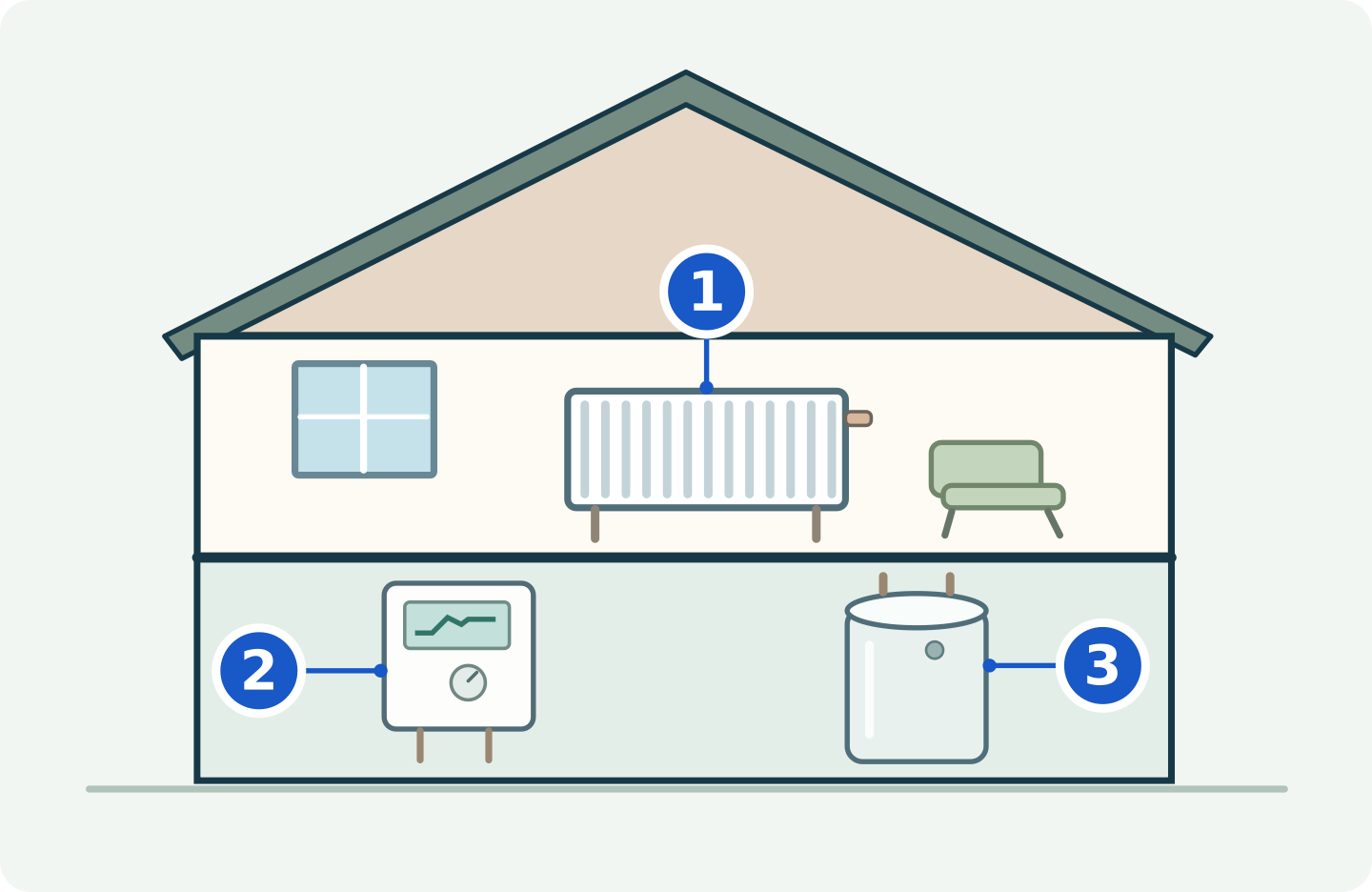
- Room radiators
Which radiators can meet each room’s heat demand? Where might a larger heating surface help?
- Heating controls
What flow temperature does the house need to keep the rooms warm on cold days?
- Hot water
How is hot water supplied today? What storage volume and hygiene arrangements suit the household’s needs?
Ask the installer to account for planned renovations when calculating the heating load. Discuss heat distribution, hydraulic balancing and the heating curve as well.
Further reading: Consumer advice centre: requirements in existing homes
External · co2online
Would a heat pump suit my house?
The WärmepumpenCheck provides an initial assessment of your building’s suitability and possible alterations. Technical planning follows with the installer.
Have ready: construction year, current heating, radiators and renovation history.
External · co2online
Which renovation deserves a closer look?
The ModernisierungsCheck compares renovation measures using modelled costs and savings. Use the result to select suitable options for an advice session; specific quotes follow afterwards.
Have ready: a heating bill with its period and consumption, plus details of the building and previous improvements.
Record your input assumptions, the result and open questions. Use these to prepare for local advice →
A real-life experience · co2online
Renovating while living in the house
Patrick describes how his family modernised an older house in stages while continuing to live there. The report combines experiences with insulation and heating replacement with organising everyday family life.
This house involved several measures and substantial DIY work; that is not a general requirement for replacing heating.
Read the experience report on co2online (external)
Collect your own questions for the specialist discussion
Report: 31 March 2026 · Link and context checked: 29 September 2026.
The installation must suit the house too.
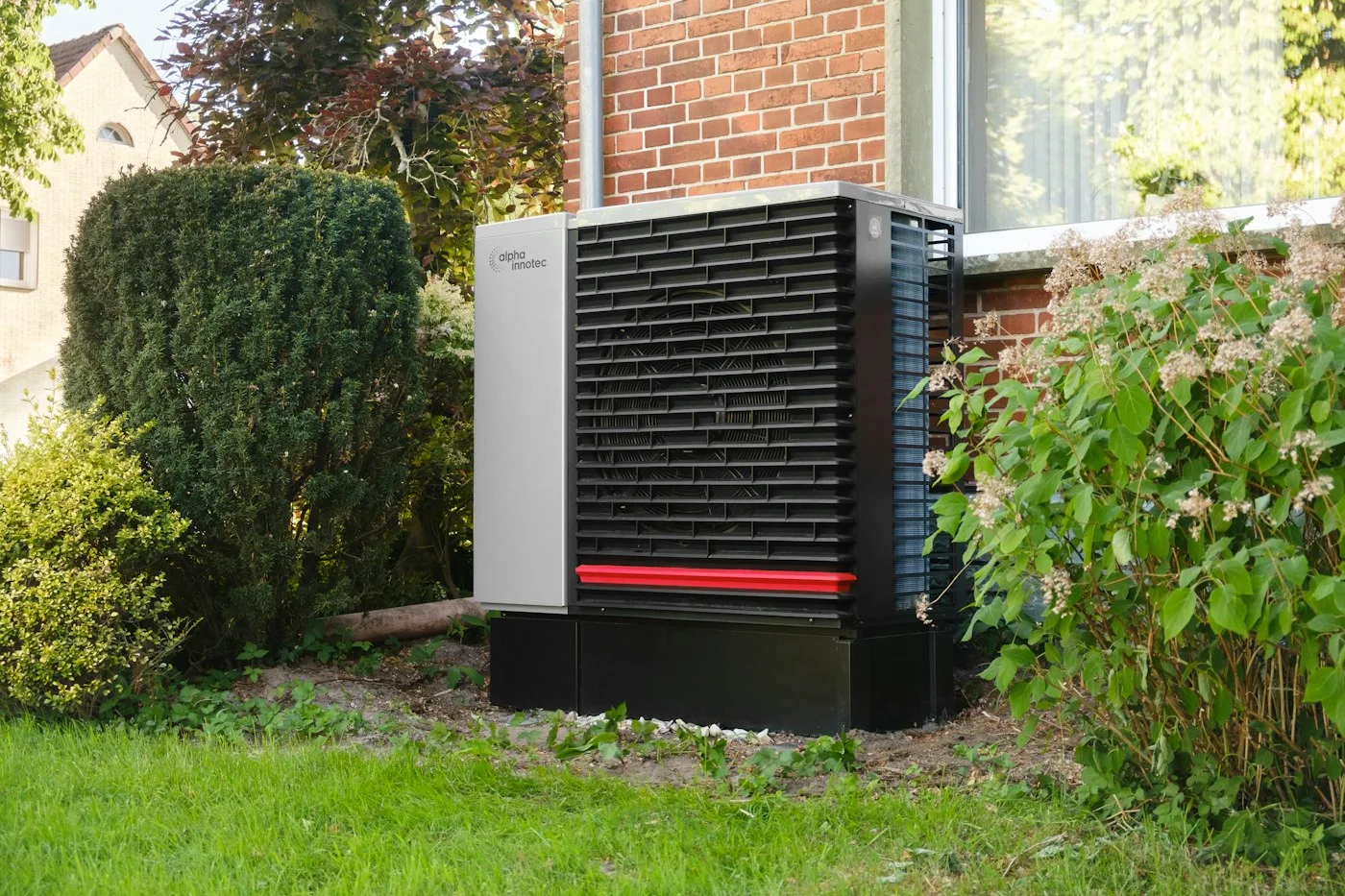
For an air-to-water heat pump, the site plan should cover noise, maintenance access, airflow, condensate and pipe routes. Discuss neighbours and rooms requiring noise protection with the installer early on; a product specification alone does not assess the location.
For ground or groundwater heat sources, source development and required permits need separate assessment. For every electrical solution, coordinate the grid connection, meters, notification and any controllability requirements with the electrical contractor and grid operator.
Air, ground or groundwater? Compare heat pump types →
For heat pumps commissioned on or after 1 January 2024 on the low-voltage grid with an electrical grid connection rating above 4.2 kW, controllability under Section 14a EnWG generally needs to be planned. Supplementary heaters count too; several heat pumps operated by the same party behind one grid connection are aggregated. Include controls, metering and recurring costs in the quote.
Section 14a and grid charge modules explained ?
Section 14a addition checked on 28 September 2026: Federal Network Agency: controllability rules.
Ask for the proposed storage, controls and electric supplementary heater to be justified. Ask when the immersion heater is expected to operate and how its consumption will be measured afterwards.
Further reading: Consumer advice centre: location and noise
Further reading: Consumer advice centre: technology and equipment
04 · Assess district heating
From a possible network connection to a usable offer.
Clarify availability alongside heat pump planning. An early enquiry can establish whether a heat network is a realistic option for your intended changeover date.
- Availability: is there specific information for your address? Which conditions and dates remain open?
- Inside the building: who plans and pays for the connecting pipe, building entry, heat interface station and alterations to heating circuits or hot water?
- Contract: what connection capacity, price components, price adjustment rules and contract terms apply? Who owns and maintains the station?
- Later renovation: how would lower heat demand affect the required and contractually agreed capacity?
District heating does not replace the building’s internal heat distribution system. Have the required building work and settings assessed for this option too.
For initial guidance: Ulm’s 2023 heat plan with its map, planning horizons and responsibilities. Record the map’s date and the supplier’s current response separately.
Further reading: SWU: district heating prices and cost components
05 · Understand energy
Heat supplied and electricity demand are different quantities.
The seasonal performance factor (SPF, known as JAZ in German) relates the heat delivered over a year to the electricity consumed for it. It describes annual operation. A laboratory or instantaneous value does not replace it.
What was measured in existing homes?
In the Fraunhofer field trial, 49 air-to-water heat pumps in 2024 achieved seasonal performance factors from 2.6 to 4.9. The mean was 3.4. The chart shows the group studied; it does not predict efficiency in your home.
Seasonal performance factors of air-to-water heat pumps

For your quote: ask for the expected seasonal performance factor and the electricity uses included to be explained. After installation, measured heat and electricity help you assess operation.
Measurement boundary, values and interpretation
JAZ3 measurement boundary: heat is measured on the generator side, before the storage tanks. Electricity includes the compressor, controls, fan and immersion heater. Storage charging and heating circuit pumps are excluded. Storage losses reduce the heat subsequently available for use. Different accounting boundaries therefore cannot be compared directly.
Values for the group studied: minimum 2.6; mean 3.4; maximum 4.9. The line shows the full range, not a frequency distribution. The report classifies the maximum of 4.9 as a statistical outlier. The sample is not representative of Ulm.
Source: Fraunhofer ISE: WP-QS in existing buildings; Final report (PDF), pp. 67–76. Report: second edition, 25 November 2025. Source checked on 29 September 2026.
An illustrative calculation with chosen assumptions
Suppose the heat pump system delivers 12,000 kWh of heat per year to the heating and hot water system being considered. With an assumed SPF of 3 for the same system boundary, it needs 4,000 kWh of electricity: 12,000 ÷ 3 = 4,000.
At an SPF of 4, the same heat output would require 3,000 kWh of electricity. The example illustrates the importance of efficiency; it predicts neither your house nor typical consumption in Ulm.
For the quote, define which heat quantities and electricity uses the figure covers, such as hot water and supplementary heating. Consumption outside that boundary may need to be added. Do not simply use the old heating system’s gas or oil consumption without checking it.
Further reading: Consumer advice centre: seasonal performance factor and efficiency
06 · Understand quotes
Compare the same task over the same period.
Ask for two transparent options where both are available. Record investment, financial support and annual operation separately for each. Use amounts including applicable taxes and the same price date.
Heat pump
- equipment, heat source development, installation, electrical work and necessary building alterations.
- electricity demand based on a justified SPF and a stated amount of heat.
- unit price, additional standing and metering charges, and maintenance.
District heating
- building connection, station, alterations and any further connection costs.
- heat delivered multiplied by the unit price, plus capacity-related standing charges.
- metering, maintenance of equipment you own and other contractual costs.
The comparison must consider heat at the same point in the house. Storage and distribution losses must be accounted for transparently in both options. A lower price per kWh therefore does not automatically mean lower annual costs.
Also calculate with a higher energy price assumption and a lower SPF for the heat pump. This makes the assumptions that particularly affect the decision visible. A single payback figure does not answer these questions.
Further reading: FUG: current and dated price sheets
The guided calculator brings together investment, assumed financial support and recurring costs over a shared period. A fictional example shows the effect of the upfront cost. Input guidance explains where to find your values. The detailed operating cost check can be expanded below it.
Heat pump or district heating?
Compare purchase and operating costs together.
What does each option cost over the same period? Start with an example or your own quotes. Each input has a short explanation.
Calculations run in your browser. Entries are not sent to the website. Only when you choose “Add to my plan” is a snapshot kept in this browser tab. You can export or clear it in the planning sheet.
My own case · leave unknown amounts blank. Only enter 0 for a confirmed zero.
All amounts include VAT. No thousands separators: 18000 instead of 18,000. You can take your open questions with you at any time.
1 · The same heat for the same house
2 · Energy and other annual costs
Use prices valid at the same date. The calculator holds these prices constant over the chosen period.
Heat pump
District heating
3 · Purchase, installation and grants
Compare the full scope of supply. Missing investment costs remain open and do not produce an apparently cheaper total.
Heat pump
District heating
4 · Other costs over the period
Heat pump
District heating
Prices, heat demand and SPF stay constant. No discounting, no price forecast and no blanket deduction for your own PV electricity.
Your comparison including investment
Take the method and results with you
Heat pump electricity = annual heat ÷ SPF. Annual costs = energy purchases × unit price + other operating costs. Costs over the period = investment − grants + years × annual costs. The extended scenario adds interest, fees, repairs and replacements, and deducts residual value.
No intermediate rounding. Displays are rounded to whole euros, so displayed totals may differ by one euro. A difference below one euro over the entire period counts as nearly equal.
Calculations run in your browser. Entries are not sent to the website. Only when you choose “Add to my plan” is a snapshot kept in this browser tab. You can export or clear it in the planning sheet. Clarify technical suitability with an energy adviser, designer and heat supplier.
Break down operating costs in detail
Here you can check additional electricity and ongoing costs individually. This second calculation excludes investment. If needed, transfer the complete additional annual costs to the corresponding heat pump or district heating step in the quote comparison; values are not transferred automatically.
Heat pumps and district heating
What does your heating cost to run?
Compare the recorded annual operating costs for the same heat supply. Use your own quotes or clearly labelled assumptions. Unknown information can remain open.
Starts without preset values. You can choose to load an example.
Calculations run in your browser. Entries are not sent to the website. Only when you choose “Add to my plan” is a snapshot kept in this browser tab. You can export or clear it in the planning sheet.
All amounts include VAT. Enter numbers without thousands separators: 18000 or 0.12. Purchase, grants, financing and replacement purchases are excluded.
Where can I find the information?
Start with the documents you already have. Missing values stay “Still open”. You do not need a complete calculator for an initial advice session.
- House and heat quantity: Bring consumption bills, building information and planned renovations to an energy adviser or heating designer. Have annual heat at the common delivery point determined, including the chosen hot-water scope. Do not use gas or oil consumption directly as Q.
- Heat pump: Ask the designer for an SPF suited to the building, including the electricity consumers it covers. A COP from the equipment data sheet cannot replace an annual value. The appropriate tariff provides electricity prices, validity and additional standing / metering charges; maintenance and other ongoing costs need to be clarified separately.
- District heating: Ask the supplier about a connection for your address, and request its price sheet and contract information. Clarify the billing point, connection capacity, standing / capacity charge, metering, maintenance and electricity on the building side.
“My assumption” identifies a deliberately chosen scenario. Only select “No additional charge” or “Already included” once the item is actually clarified. Information from a quote must match the common task and comparison date.
1 · My house and the common heat quantity
Gas / oil purchases, floor area and heating costs are not a direct heat quantity. The calculator does not estimate boiler efficiency or heat load from them.
2 · My heat pump
The date you retrieve a price and its validity are different things. Fixed costs must also match the chosen pricing date.
Additional electricity outside the main energy boundary
Other ongoing costs
Check every item. An explicitly confirmed zero or a reference to an amount already included avoids double counting. Include shared costs on the building side in both options.
3 · My district heating
The date you retrieve a price and its validity are different things. Fixed costs must also match the chosen pricing date.
Standing and capacity charges
Additional electricity outside the main energy boundary
Other ongoing costs
Check every item. An explicitly confirmed zero or a reference to an amount already included avoids double counting. Include shared costs on the building side in both options.
4 · My comparison
Recorded annual operating costs under these assumptions. Investment, grants, financing, repairs and replacement purchases are not part of this total. This is neither a purchase recommendation nor confirmation of connection availability. PV generation is not simply deducted from annual electricity demand.
What changes with a different assumption?
Change one value at a time; all other entries stay the same. These are your own scenarios, not a statistical spread or forecast.
Method and limitations
Heat pump electricity = Q / SPF. District heating purchases = Q / factor; use factor 1 when deliberately using the same quantity. For each option: energy × unit price + recorded additional electricity × its price + fixed annual costs. Linear capacity charges = the greater of capacity × price and the minimum charge.
Monthly amounts are explicitly multiplied by twelve. There is no intermediate rounding. The overview shows whole euros and the breakdown shows cents; the difference uses unrounded totals. Differences below 1 euro per year count as nearly equal.
The model does not cover price changes within a year, dynamic electricity tariffs, time-dependent PV use or allocating heating costs between tenants. Quotes and system boundaries still require professional review. Model version R04 0.1.0.
Take your values and open questions with you
The text report includes your entries, sources, pricing dates and open points. You can add it to your planning sheet.
Financial support and contracts belong in the sequence.
Before making binding commitments, check financial support for your building, ownership situation and chosen technology. KfW programme 458 is a key starting point for replacing heating in existing residential buildings; the conditions currently stated there are authoritative.
KfW specifies a sequence involving professional confirmation and a supply or service contract containing the required funding condition. The application must be submitted before the project begins. Have the sequence for your project explained before signing a contract or starting work.
Include municipal grants only if the relevant programme is currently accepting applications and your project meets its conditions. A previous grant approval for other projects is not sufficient.
07 · From order to operation
Agree how good operation will be recognised too.
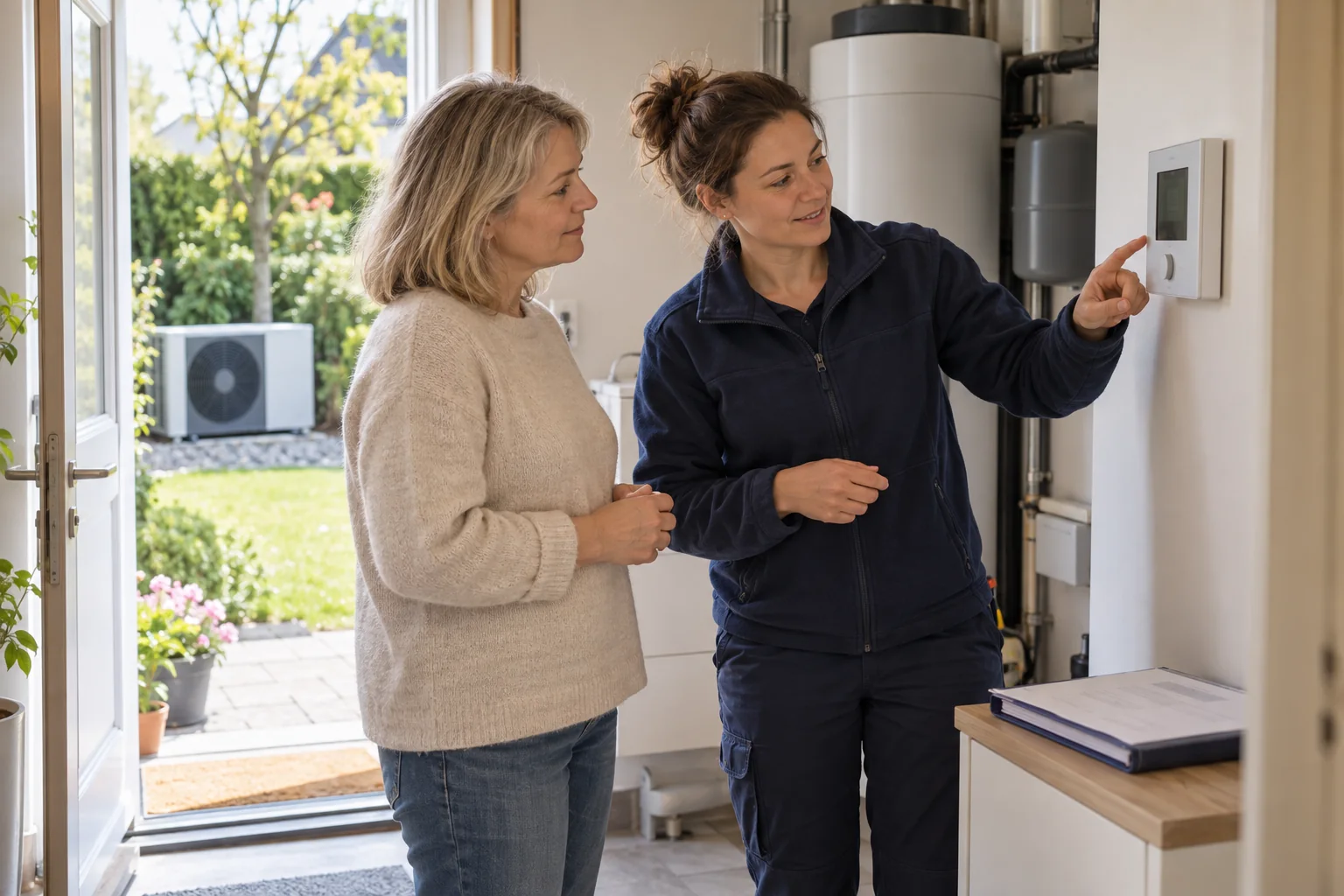
- Before installation: coordinate the tasks of the heating contractor, electrical contractor and, where relevant, heat network operator. Record dates and how heat will be supplied during the work.
- At handover: document settings, balancing, meter readings, user manuals and responsibilities. Ask for the controls to be explained.
- After the first heating season: review comfort and consumption together. For a heat pump, suitable electricity and heat measurements help; for district heating, also check billed capacity and contract components.
If some rooms stay cold or consumption is unusually high, collect observations and discuss them with the installer. Changes to hot water hygiene, electrical equipment and safety-related settings require qualified professionals.
For further planning, the renovation guide from Zukunft Altbau takes you through ten steps, from preparation through quotes and construction to completion and upkeep.
Your outcome
Six questions for your next discussion.
- Which solution is actually available for my building and timetable?
- Which building data and heat load underpin the design?
- What work on the building, heat emitters, hot water and connection is included in the quote?
- What heat output, SPF or connection capacity and prices have been assumed?
- How are one-off and recurring costs split – and what happens if assumptions change?
- Who handles the funding process, coordination, commissioning and subsequent performance checks?
Your next step: collect the documents and first resolve open questions about the building and availability. You can then request quotes with matching scope.
Adding PV and an electric car later? Consider the projects together.
My next step
- What I know: the reason, timescale and available building information have been recorded.
- What is still open: which heat supply is available for this house, and by when? Which assumptions are missing for comparable quotes?
- Who can help: the heating contractor and energy adviser; the relevant supplier provides specific district heating information.
- What I will do next: I collect the documents I have and ask about connection availability, timing and outstanding conditions. Unknown costs remain marked as open.
Sources and further information
- Consumer advice centre: heat pumps and SPF
- Consumer advice centre: requirements in your own home
- Consumer advice centre: technology and equipment
- Consumer advice centre: operation and location
- FUG: price sheets and terms
- SWU: district heating overview
- KfW 458: heating support and application steps
- Regional Energy Agency Ulm
Editorial status: 18 September 2026. Connection availability, quotes and support conditions must be checked for the specific project.