



Home / Solar PV and battery storage
Plug-in solar · Flats and balconies
Your own solar electricity. Even in a flat.
From finding a suitable location to registration: work through how balcony solar could fit your home, with a simple example and a preparation checklist.
Jump to Tenants and owners’ associations · Equipment and connection · Costs and Ulm · Estimate generation · Registration.
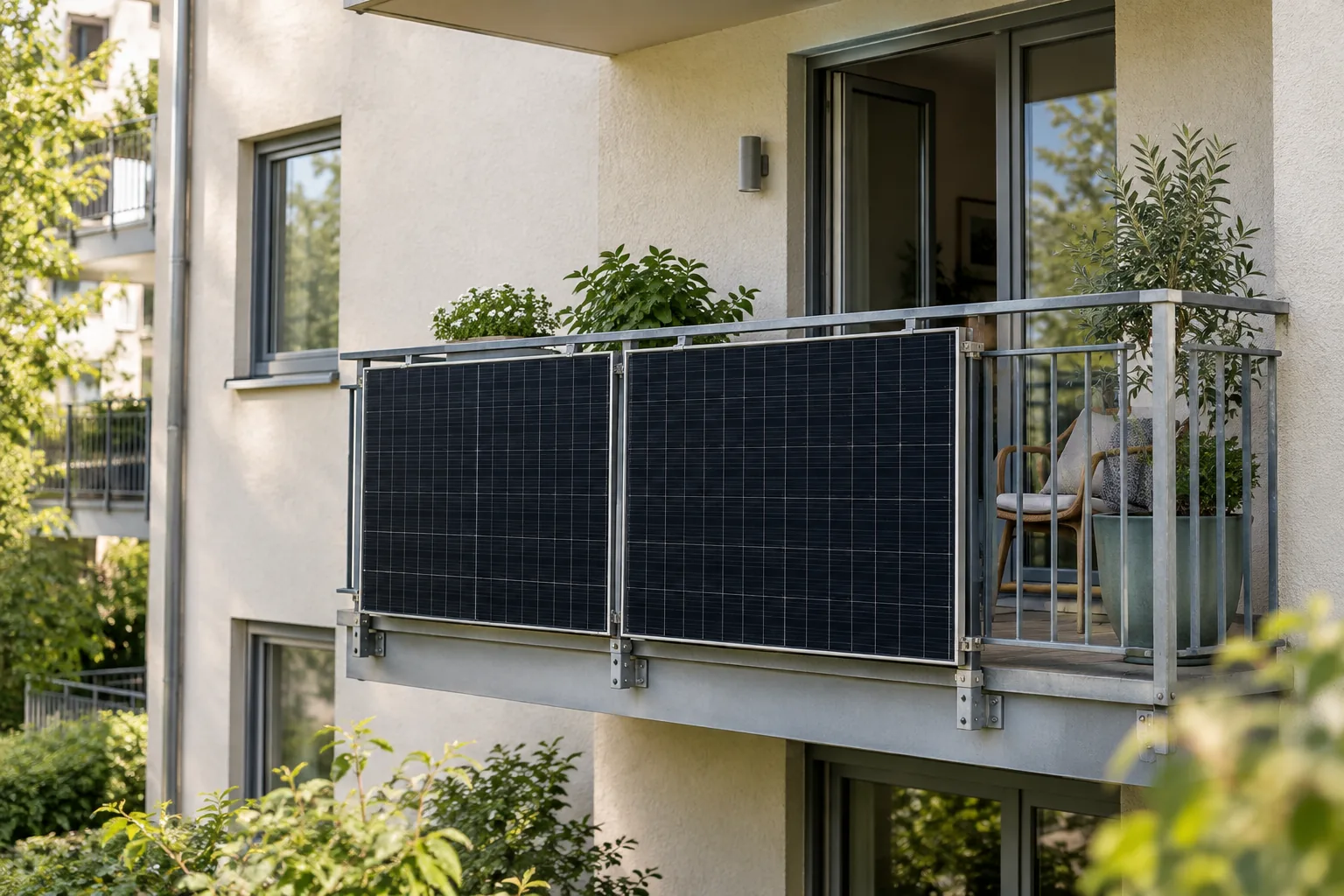
01 · Location
Where is there room for sunshine?
Photograph your balcony from the same spot at different times of day. Compare the light and shade and record the dimensions for your sketch.
Morning
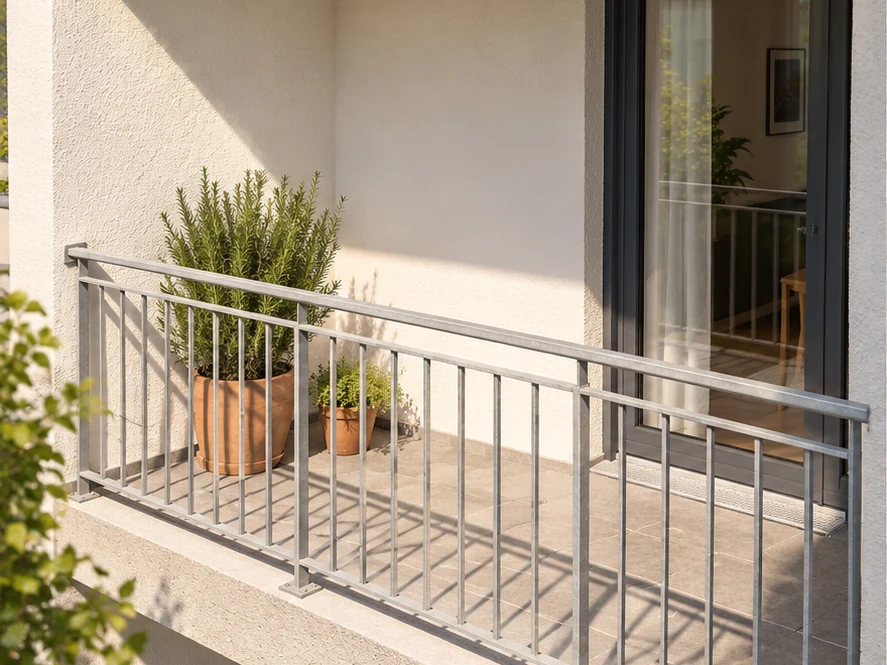
- Usable width
Measure the clear span of the railing and the available height. Add both to your sketch.
- Door and access
Mark where the door opens and which access routes need to stay clear.
Afternoon
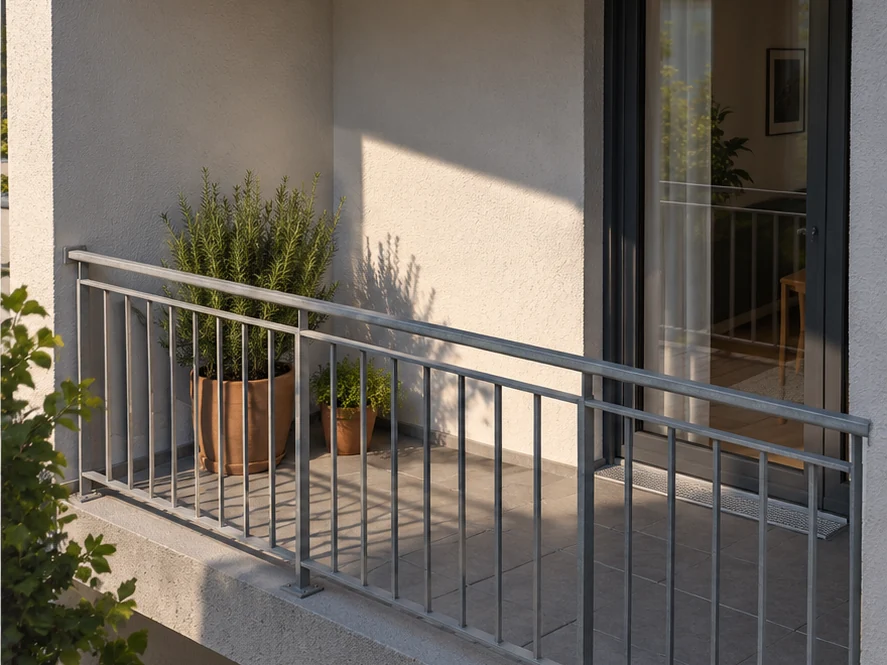
- Edge of the shade
Later in the day, the shadow reaches a different part of the balcony. Note the time and what casts the shadow. Observe the site in other seasons as well.
AI-generated views of the same illustrative balcony.
Plug-in solar can supply part of your flat’s electricity. The inverter makes the modules’ output usable at home. The grid supplies any shortfall, while unused surplus flows back into it. When you need electricity therefore matters too.
- Mounting: Does the proposed mounting system suit the railing or surface? It must safely withstand the weight and wind loads. Seek professional advice if the fixing is uncertain.
- Daily routine: Which appliances already need electricity during the day? Generation and use need to coincide.
Explore further: Consumer advice centre: location, mounting and how it works
Take your photos and dimensioned sketch to the discussion about mounting and consent.
No suitable balcony? Explore solar electricity from a shared roof. For your first enquiry, simply explain your interest and ask about existing plans and a person to contact.
02 · Coordination
Who needs to be involved before installation?
You rent your home
Obtain your landlord’s permission in advance for structural alterations. Section 554 BGB strengthens your right to permission for plug-in solar; however, reasonableness and legitimate interests may weigh against it in individual cases. Agree on the specific installation.
Explore further: Section 554 BGB: right to permission
You own your flat
If common property is affected, the decision goes through the owners’ association (WEG). Section 20 WEG lists plug-in solar as a privileged structural alteration. A decision on how it is carried out is still required; coordinate this with the property manager.
Explore further: Section 20 WEG: structural alterations
Prepare details of the location, equipment, mounting and cable route. Record responsibility for costs, maintenance and possible removal in writing. For a rented flat within an owners’ association, the landlord may also need to arrange approval through that association.
What needs to be considered for a listed building?
Before ordering or installing, check with the responsible authority whether heritage protection or other building requirements apply. Permission from the landlord or owners’ association does not automatically settle this question.
Explore further: Consumer advice centre: special building requirements
A real-life experience · co2online
Balcony solar in a rented flat
Irene explains how a solar module she won became a balcony solar unit at her rented flat. Her account shows the time involved in coordination, preparing the connection and organising installation.
The project dates from 2023. The requirements described at that time are not a guide to today’s approval process; use the current guidance on this page for that.
Read the experience report at co2online (external)
View the preparation checklist
Report: 9 March 2026 · Link and context checked: 29 September 2026.
03 · Selection and connection
What power rating – and which plug?
Compare a complete system with clear product documentation: modules, inverter, connection cable, plug and suitable mounting hardware. The installation and connection instructions must suit your intended use.
EEG: the simplified route
The special rules apply to a combined maximum of 2,000 Wp of module capacity and 800 VA of inverter output behind the same point of electricity supply. This route includes unpaid acceptance of exports: you receive no payment for surplus electricity fed into the grid.
Product standard: connection type
DIN VDE V 0126-95:2025-12 provides for a household plug with no more than 960 Wp of module capacity and additional protective measures for the complete system. For up to 2,000 Wp, this standard provides for a special energy connector.
The 2,000 Wp limit alone does not approve use of an ordinary socket. Have a qualified electrician check whether the circuit is suitable. New sockets, installation changes and a special feed-in socket are their responsibility. Do not use a multi-socket extension.
Explore further: VDE/FNN: connection and requirements
Explore further: DKE: product standard and protective measures
Wp, VA and kWh – what does each figure mean?
Wp describes the modules’ rated power under defined test conditions. VA refers here to the inverter’s maximum apparent power on the grid side. kWh is the energy generated or consumed over a period of time. None of these power ratings guarantees a particular annual yield.
Can I simply turn down a more powerful inverter?
A lower setting alone is not enough for the EEG special rules: where power levels can be selected, the Federal Network Agency uses the highest selectable value. Check the manufacturer’s documentation, rather than only the current app setting.
Explore further: Federal Network Agency: power limits and output restriction
04 · Understand the benefit
Electricity generated does not automatically equal grid electricity saved.
An illustrative example without a battery: For two hours, the unit generates a constant 300 W. Your flat needs a constant 150 W during that time. There are no other generators; these figures apply on the household side of the inverter.
0.6 kWh generated
300 W × 2 h = 600 Wh, or 0.6 kWh.
0.3 kWh used on site
150 W × 2 h = 300 Wh. Another 0.3 kWh flows into the grid.
Without a battery, the exported share is not available again in your flat that evening. A generation display alone therefore does not show your savings.
What changes if consumption is higher during that time?
If the flat needs a constant 500 W in the same example, all 300 W of solar output is used at once. The missing 200 W comes from the grid: 0.4 kWh over two hours. Increasing consumption just to raise self-consumption does not save energy.
The example explains the energy balance at the same time. It is neither a measurement from Ulm nor an annual forecast. In practice, generation and consumption vary.
Include the full costs.
List the equipment price, mounting hardware, delivery, installation and any necessary electrical work separately. Ask what each quote includes and what extra work may be needed on site. Savings depend on the kilowatt-hours you actually use yourself and your electricity price.
Ulm · Checked on 18 September 2026
The city programme is currently closed to new applications.
The City of Ulm reports that applications and funding have been suspended since 1 September 2026 under the Ulm energy funding programme. Plan a new purchase without this grant. According to the city, eligible applications submitted by 31 August will still be paid.
Always check funding conditions before placing an order. Neu-Ulm and other municipalities have their own programmes and responsible authorities. Costs and funding overview.
What could your location generate?
HTW Berlin’s plug-in solar simulator provides an initial estimate of self-sufficiency and financial value. Compare two suitable sizes using your location and consumption assumptions. Replace suggested costs with a specific quote.
How to use the result: Record generation, the share used on site and savings separately. Then test a less favourable assumption, such as less usable sunlight. A calculation does not confirm safe mounting or the compliance of an equipment combination.
External calculator on HTW Berlin’s website. Its documentation explains the model assumptions; the result does not replace site-specific planning.
05 · Starting and registration
What needs to be registered?
Once permission, mounting and connection are settled, commission the unit according to the manufacturer’s instructions. For a unit following the simplified route described above, register it in the Core Energy Market Data Register within one month of commissioning. Under these conditions, no separate notification to the network operator is required.
- Have the location, commissioning date, meter number and module and inverter ratings ready.
- Use the official register and keep the registration confirmation with the product documentation.
Do I need to wait for the meter to be replaced?
Under the simplified route, the unit may operate before any necessary meter replacement. An old meter running backwards is temporarily tolerated. The responsible metering operator arranges replacement; do not alter the meter yourself.
Explore further: VDE/FNN: registration and meters
For higher output, paid grid exports or an additional battery, clarify the appropriate process separately. Do not automatically apply the simplified rules to these cases.
06 · Operation
After starting: monitor performance and keep your records.
- Generation: Check the intended display or metering. Compare similar weather conditions; a dark winter day cannot be compared with a sunny summer day.
- Condition: Follow the manufacturer’s inspection and maintenance guidance. Seek professional help if you notice problems with the mounting, cable or connector.
- Insurance: Ask your insurer how the unit and possible damage are covered by your existing policy.
- Documentation: Keep the invoice, permission or resolution, installation documents, registration and contact details together.
Explore further: Consumer advice centre: measurement, operation and insurance
Will I still have electricity during a power cut?
A conventional grid-connected plug-in solar unit does not supply your flat during a grid outage. A separate emergency-power function in a battery would be a distinct product feature and must be expressly designed for that purpose.
Your preparation
Six points for your next discussion.
Copy this checklist into your notes. For each item, add: resolved, outstanding or responsible person. Keep the photos and documents with you.
- Location: Photos, dimensions, orientation and observed shading.
- Coordination: Contact at the landlord or property manager; planned permission or resolution.
- System: Product details, total module capacity, inverter rating and evidence for the intended connection type.
- Safe installation: Suitable mounting hardware and clarification of any checks or work needed on the electrical installation.
- Costs and benefits: A complete quote, your consumption and transparent simulation assumptions.
- Getting started: People responsible for installation and registration, plus a place to keep confirmations.
If something remains unresolved, make that question your next step. A low price does not make an unsuitable or unconfirmed mounting location suitable.
What if your situation is different?
Do I need a battery for plug-in solar?
A battery is a separate decision. Compare the additional cost, usable capacity, losses and consumption after sunset. The product standard mentioned covers units without batteries; combinations need further requirements to be clarified. Simplified registration of the solar unit does not replace the required battery registrations either.
Explore further: DKE: scope concerning units with energy storage
Explore further: Consumer advice centre: batteries and registration
The balcony is unsuitable. What other options are there?
Consider another suitable location with permission, or discuss a shared roof project with the landlord and owners’ association. Plug-in solar, tenant electricity and shared building supply have different requirements. Start by asking the landlord or property manager about existing plans. The guide to a shared solar roof explains roles, models and preparation.
Solar electricity options at a glance · Solar PV for your home.
Sources, example assumptions and status
- Consumer advice centre: plug-in solar at home
- Consumer advice centre: frequently asked questions
- Section 554 BGB and Section 20 WEG
- Federal Network Agency: EEG special rules and power ratings
- VDE/FNN: connection, registration and meters
- DKE: product standard DIN VDE V 0126-95:2025-12
- HTW Berlin: plug-in solar simulator and documentation
- City of Ulm: current status of the energy funding programme
Editorial and source review: 18 September 2026. This guide mainly covers a new plug-in solar unit without a battery under the simplified procedure. The two-hour example uses illustrative, constant assumptions. Discuss the specific installation and any special building requirements with the relevant professionals. Check funding status and equipment requirements again before ordering.