



Home / Solar PV / Your own home
Solar PV · Your route for your own home
Your roof. A clear route to your own solar system.
Would you like to generate solar electricity and know where to start? This guide takes you from the first roof assessment through comparable quotes to the handover of your system.
For your own single-family or two-family home. For a shared roof, first agree on how decisions will be made with the property manager and other owners. For a flat, you can also explore plug-in solar.
Key points at a glance
- Check your roof first: Have its condition, usable area, shading and planned roof work assessed. The solar map provides an initial guide.
- Consider your electricity needs: Gather consumption figures and typical usage times. Include plans for a heat pump or electric car.
- Compare complete quotes: Assess equipment, scope and total price on the same basis. Ask for the benefits and additional cost of a battery to be explained separately.
- Prepare for connection and operation: Agree who will handle connection applications, registration and the handover. Keep the documents, access details and service contacts.
Where are you now?
Start with your next unanswered question. You can jump straight to any section. Is your roof shared by several homes? Explore a shared solar roof for tenants and owners’ associations.
01 · Roof
Establish the starting point
Which roof areas and planned works need to be considered?
02 · Potential
Use the solar roof map
Find an initial assessment and note outstanding questions.
03 · Demand
Understand your electricity use
Gather information on current demand, daily routines and future plans.
04 · Quote
Compare what is included
Compare technology, assumptions and costs transparently.
05 · Connection
Coordinate registrations
Assign responsibility for grid connection, billing and the register.
06 · Operation
Get a proper handover
Know your documents, how to operate the system and who to contact next.
01 · Roof
What needs to be checked at the building?
A simple sketch is useful for your first conversation. Draw the roof slopes and mark these three features.
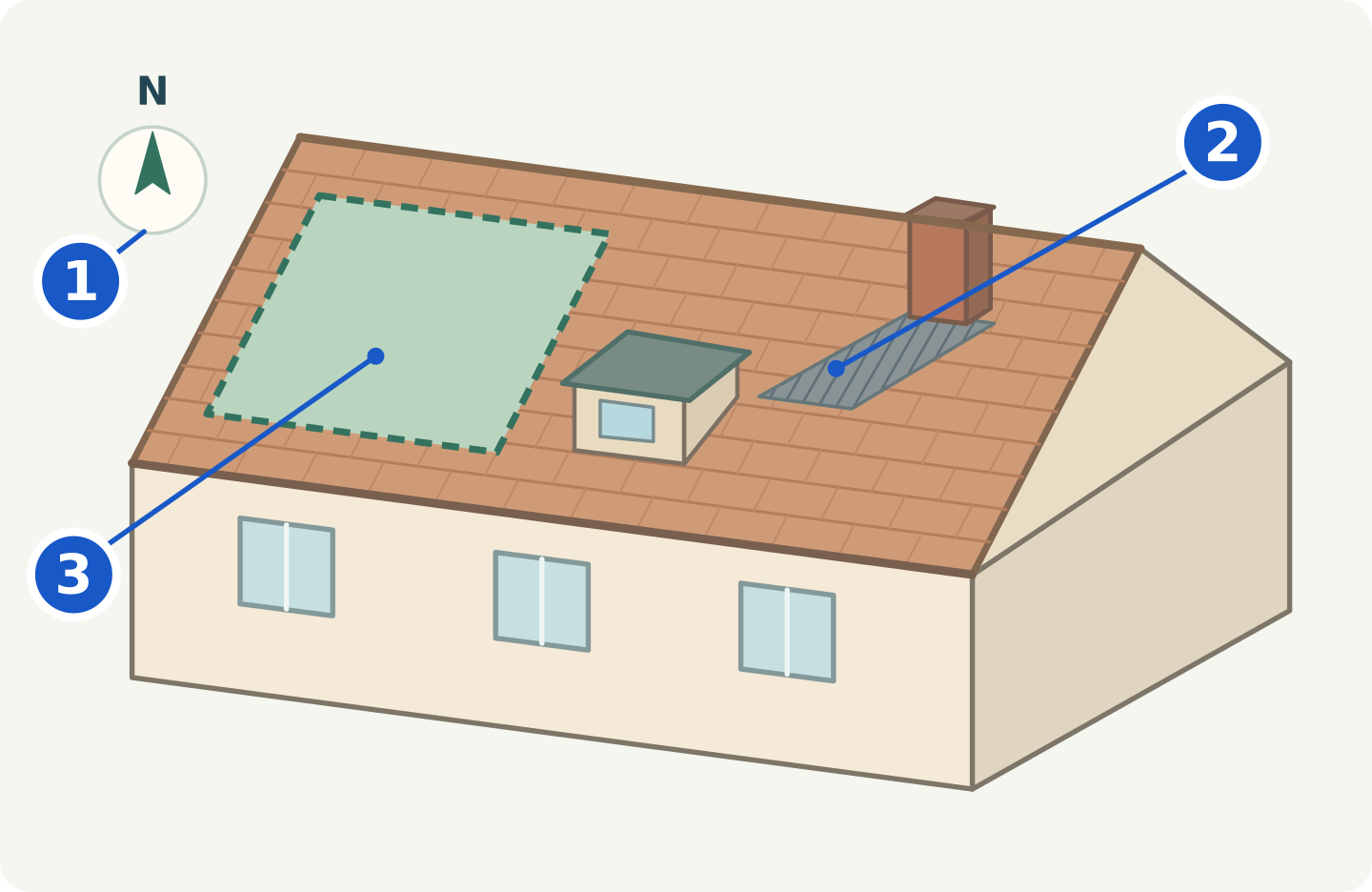
- Orientation
Which direction does each roof slope face? Add a north arrow to your sketch.
- Shade
Where do a chimney, dormer, trees or neighbouring buildings cast shade? Record the time of day and season of each observation.
- Available area
Which areas are clear between roof features? Mark skylights and any access routes that need to stay open.
During the site visit, the installer checks roof condition, load-bearing capacity and cable routes. If roof repairs are planned, coordinate their timing with the PV installation.
Also clarify which local and building regulations apply to your project, especially for a protected building. The installer assesses its specific technical suitability.
Roof work in Baden-Württemberg: check the PV requirement early
For new residential buildings, the PV requirement generally applies to building applications or complete construction documents submitted from 1 May 2022. For existing residential and non-residential buildings, it covers major roof renovations with construction starting from 1 January 2023, where suitable areas are available.
A major renovation means completely replacing the roof waterproofing or covering. Work solely to repair short-term damage, such as storm damage, is excluded. There is therefore no blanket retrofitting requirement for every unchanged existing roof.
Before placing an order: have the suitable area, required scope and route to compliance checked. Exceptions and exemptions are different cases; the responsible local building authority decides on a requested exemption. The state’s FAQs also explain alternative measures and evidence requirements.
Sources checked on 28 September 2026: Baden-Württemberg Environment Ministry: PV requirements and roof renovation.
Your milestone: a sketch or existing roof photos and a list of points still to be checked.
Explore further: Consumer Advice Centre’s energy advice service: requirements and planning
02 · Potential
View your own roof in the solar map.
- Search for your address: open the Energy Atlas map showing rooftop solar potential and select your building.
- Compare the display: do the roof shape, structures and visible shading match your home?
- Calculate with your own figures: click “Wirtschaftlichkeitsrechner” (financial calculator) in the building information. Check consumption, electricity price, roof layout and costs. Our guide explains the four steps and the comparison with and without battery storage. Record results, assumptions and discrepancies for your discussion with the installer.
The map shows my roof incorrectly. What now?
Building data and aerial surveys may predate your house or alterations. Roof windows and other details are not always represented correctly either. A missing map entry is therefore not a reason to rule out PV. LUBW describes the service as initial guidance; design and approval take place separately.
Explore further: LUBW: data, discrepancies and next steps
03 · Demand
How does solar electricity fit your everyday life?
Bring your electricity bill and describe typical times of use. Add planned changes, such as an electric car, heat pump or another person in the household. When electricity is needed matters too.
Capacity: kWp
The rated power of the PV modules under defined test conditions. It describes the system size.
Energy: kWh
The amount of electricity generated or consumed over a period, such as a year.
Solar electricity through the year: a model example for Ulm
The same system, different seasons: for an illustrative 10 kWp system in Ulm, PVGIS gives a long-term average of around 11,100 kWh per year. Around 67% of generation falls between April and September.
Average generation of a 10 kWp system over one year

For your planning: the annual total alone does not tell you how much solar electricity you can use yourself. Generation and consumption must also coincide in time. Consider electricity, heating and mobility together →
Assumptions and limitations of the model example
Example location in Ulm: 48.40° N / 9.99° E. 10 kWp of crystalline-silicon modules, south-facing, with a 35° tilt and a freely ventilated mounting model. System losses are set to 14%; PVGIS accounts for temperature and irradiance effects separately. The terrain horizon is included; individual shading from trees, neighbouring buildings or roof structures is not captured.
Calculated with PVGIS 5.3, the SARAH3 irradiance database and weather data for 2005–2023. The bars show average generation for each month, rounded to whole kWh. Individual years and actual roofs will differ. This is neither a yield guarantee nor a statement about the whole city. Battery storage, self-consumption and system-specific export limits are not included in this energy balance.
All twelve monthly values as a table
| Month | kWh |
|---|---|
| January | 408 |
| February | 630 |
| March | 1,028 |
| April | 1,233 |
| May | 1,264 |
| June | 1,329 |
| July | 1,346 |
| August | 1,251 |
| September | 1,084 |
| October | 758 |
| November | 441 |
| December | 375 |
Rounded to whole kWh, so the sum may differ slightly from the rounded annual figure. The chart and table use the same monthly averages.
Our own visualisation using PVGIS / European Commission, JRC. calculation method · calculation with all inputs (JSON). Data retrieved and checked on 29 September 2026.
Self-consumption and self-sufficiency: a numerical example
Freely chosen example without a battery: a system generates 8,000 kWh per year. The household needs 5,000 kWh in total. Of this, an assumed 2,500 kWh is supplied by solar electricity generated at the same time.
- Self-consumption rate: 2,500 ÷ 8,000 = 31.25%. This share of generation is used on site.
- Self-sufficiency rate: 2,500 ÷ 5,000 = 50%. This share of household demand is covered by its own generation.
- Remaining amounts: 5,500 kWh exported to the grid and 2,500 kWh imported in this simplified annual balance.
The 2,500 kWh of simultaneous self-consumption is an assumption, not a result derived from the two annual totals. A sound estimate requires generation and consumption to coincide in time. This example is not a yield forecast for your roof.
Your milestone: Your consumption and future plans are known. A professional design can build on these without promising a standard self-consumption rate.
Explore further: Consumer Advice Centre’s energy advice service: self-consumption and future demand
Use your own electricity or export it all?
Self-consumption with surplus export
You use solar electricity in the house and export the remaining surplus to the grid. The benefit comes from avoided electricity purchases and payments for exported electricity. The overlap between generation and consumption is crucial.
Full export
All generated solar electricity is accounted for as grid export; you continue to buy household electricity through your electricity contract. Eligible building-mounted systems receive higher tariff rates than surplus-export systems, subject to the statutory conditions.
Ask for a comparison: calculate both options using the same roof area, realistic generation, current and future consumption times, and all metering and operating costs. The higher export tariff alone does not determine the better result. Rates and eligibility depend on factors including capacity and commissioning date; agree on the arrangement with the installer and network operator in advance.
Sources checked on 28 September 2026: Federal Network Agency: operating arrangements · current EEG support rates.
Get an overview · then compare quotes
From roof potential to a suitable PV option.
External tool
PhotovoltaikCheck · co2online
Which PV option suits my home?
You need: postcode, building type, annual electricity consumption and roof details; also consider a planned heat pump or electric car.
You receive: an initial estimate of generation, self-consumption and financial performance for different options.
What the result tells you
A model calculation for guidance, not guaranteed generation or an on-site assessment. For apartment buildings, the check only models full export, not allocation to individual flats.
Continue here afterwards: Compare specific PV purchase quotes →
How to use the result.
- Note the system capacity, battery assumption and electricity consumption used.
- Have the installer assess the roof, shading and generation specifically.
- Then compare two quotes covering the same scope.
In an apartment building, shared supply or tenant electricity requires its own design.
Provider information for PhotovoltaikCheck checked on 28 September 2026. Data is entered on co2online’s website.
04 · Quote
What exactly do you get for the total price?
Ask several installers for quotes on the same basis. Have the site checked and missing items identified. A package price alone does not show whether the scope is comparable.
New: record package prices and extra costs side by side, collect outstanding questions and take the results sheet with you. The checklist below helps you prepare.
Check two PV quotes side by side.
Have both quotes ready. Note the same points for A and B. A blank means “still to clarify”, not “free”.
- 1 · Starting point: record the date, roof areas considered, system concept and intended use. A shared roof for several homes may need a different comparison.
- 2 · Technology: compare PV capacity in kWp, module layout, manufacturers and equipment models, including the inverter. Ask for any battery to be shown separately with its usable capacity and price.
- 3 · Scope: check scaffolding, installation, cables, necessary electrical and meter-cabinet work, connection coordination, commissioning, documentation and user instruction. Mark each item as included, priced separately, confirmed unnecessary or still open.
- 4 · Price: record the total payable, including any applicable taxes and confirmed additional costs. Do not add included items a second time. First ask the installer about missing costs.
- 5 · Outstanding questions: compare payment and delivery terms, warranties, excluded work and responsibility for faults. Resolve differences and follow-up questions before deciding.
Euros per kWp can supplement the cost breakdown. Different capacities, components and scopes do not, however, make this a fair comparison of quality or financial performance on its own.
Fictional example: why the package price can mislead
Two quotes cover the same 10 kWp PV system without a battery. A quotes €15,000 and B €16,200. Necessary electrical work is not yet priced in A but is included in B. A complete price comparison is not possible until that amount is known.
If the installer later confirms €1,800 of additional costs for A and the rest of the scope is clear, the totals are A = €16,800 and B = €16,200. The initially lower package price then results in a recorded purchase cost €600 higher.
Freely chosen figures for learning, not market prices or a recommendation. Generation, quality, running costs, financing and contract terms have not yet been assessed.
How do I compare financial projections?
Ask for generation, self-consumed electricity, grid export, electricity-price assumptions and running costs to be shown separately. Compare a more cautious case with the provider’s calculation. If the quote includes a battery, ask for an option without one and for its additional benefit and price.
Self-consumption with surplus export and full export are different system concepts. Ask for the appropriate option to be explained. Check funding conditions for your specific project before placing an order. More on understanding costs and funding.
Explore further: Consumer Advice Centre’s energy advice service: system concepts
Explore further: Consumer Advice Centre: quotes and system planning
Your milestone: You can explain why the quotes differ and which questions remain before a decision.
Working together
What else should the system be able to do later?
Battery storage
Assess the additional benefit separately.
How much electricity could be shifted from daytime to evening? Ask for a clear explanation of demand, size and extra costs.
Electric car
Consider charging times now.
When is the vehicle at home? Which devices need to communicate? Record these questions for the quote.
For joint planning with a future heating system: consider PV, an electric car and a heat pump together.
Plan grid electricity demand together: Section 14a EnWG may be relevant for a new home charger, heat pump or battery capable of charging from the grid. Clarify whether the devices will be controlled directly or together through an energy management system. Understand controllability and network-charge options ?
Experience in practice · co2online
Start with solar PV, plan further steps
Claudia combines a PV system on her terraced house with roof insulation and plans to replace the heating system next. She also reports delays in arranging grid export; an update from February 2026 adds the outcome.
An example of planning in stages. System scope, battery storage and future heating need to suit your own building and demand.
Read the experience report on co2online (external)
Gather documents for your own PV plans
Report: 11 February 2026 · Link and context checked: 29 September 2026.
05 · Connection
Who handles each step?
Solarspitzengesetz and smart meters: check commissioning date, capacity, metering and control together for your system. Our guide explains export limits, negative electricity prices and the installation of smart metering systems. Understand PV rules and metering →
First identify the responsible electricity network operator. Within the Ulm Netze electricity network area, the operator describes the following process for rooftop systems:
- Preliminary enquiry: you or your appointed installer submit an enquiry through the network portal. After a successful assessment, you receive confirmation of grid export approval with a preliminary enquiry number.
- Registration: the installer uses this to register the system. Technical review is followed by permission to install and a registration number.
- Commissioning request: the installer submits the request and, once processed, agrees a date with the metering operator.
- Meter and start-up: the meter is installed or replaced and, where applicable, commissioning takes place on site.
- Billing: for EEG billing, Ulm Netze also requires commercial registration using the customer data form in its network portal.
Explore further: Ulm Netze: current process for generation systems and battery storage
What about the Core Energy Market Data Register?
Registration in the Federal Network Agency’s Core Energy Market Data Register (Marktstammdatenregister) is also required. Agree who will enter the details for the system and any battery, which deadlines apply and where confirmations will be kept. Register obligations are separate from the network operator’s connection process.
Registration help for solar systems and batteries · MaStR obligations and deadlines
Your milestone: A responsible person has been named for each of connection registration, the register and billing.
06 · Operation
Understand the system and keep the documents.
Use the handover to ask four practical questions:
- Documents: where are the system plan, equipment data, testing and commissioning documents, and registration confirmations?
- Operation: where can I see generation, grid import and export? Which indication means there is a fault?
- Access: do I have the agreed access to system monitoring and an explanation of the main displays?
- Service: who can I contact with questions, which checks have been agreed, and what costs may arise?
After handover: keep track of operation
- Monitor generation: regularly check generation and fault messages. Compare unusual changes with the season, weather and possible shading; contact the installer if a drop remains unexplained.
- Agree on inspections: record the maintenance scope, manufacturer guidance, costs and responsibilities. Have the need for cleaning assessed from the actual condition.
- Clarify insurance: notify your building insurer of the system and record in writing which damage, deductibles and any loss of generation revenue are covered.
- Keep records up to date: store generation summaries, changes, invoices and service reports together with the handover documents.
Operating checklist checked on 28 September 2026: Consumer Advice Centre: system operation · insurance cover.
Your milestone: You can understand how the system is operating and know who can help.
Existing PV system · checked 3 November 2026
After 20 years: what next for my PV system?
The end of the original EEG payment period does not automatically end the system’s useful life. First have its safety, condition, output and likely repairs checked.
- Continue exporting. For eligible systems up to 100 kW after their original support ends, the current follow-on arrangement provides payments through 31 December 2032. It uses the annual solar market value, capped at 10 ct/kWh, less marketing costs. The old fixed payment rate does not continue.
- Check self-consumption. How much can the household or EV use at the same time as generation? Compare avoided electricity purchases with forgone export revenue, conversion, metering and running costs. Confirm the metering setup and conversion with an electrical contractor and grid operator.
- Compare before modernising. Request separate comparisons for continued operation, necessary repairs and a new system. Assess a battery as an additional option; a battery is not required for self-consumption.
What should I bring to the discussion?
Commissioning year and current payments, system capacity, recent annual output, household consumption, existing meters, inverter age and known defects. Have the end date and follow-on eligibility confirmed for your system.
Discuss connection and metering with Ulm Netze →
Legal basis: § 25 EEG · § 23b EEG · BMWE: Solar Package, question 4.6 · German Environment Agency: continued operation. No fixed future payment forecast. Recheck the rules and the deductions applicable to your year before deciding.Your next step
Take a small set of documents to the discussion.
- Address, existing roof photos or plans, and timing of planned roof work.
- Latest electricity bill and a brief description of typical consumption times.
- Plans for an electric car, heat pump or other major changes.
- Notes from the solar roof map, including open questions and assumptions.
- Your goals, budget range, preferred timing and any quotes already received.
For independent guidance, the City of Ulm lists the Regionale Energieagentur Ulm (regional energy agency). Discuss the specific technical design and installation with a qualified installer.
Back to the solar PV overview · Go to the six steps
My next step
- What I know: I record my roof details, current electricity consumption and possible future plans.
- What remains open: which assumptions need checking at the site visit? When would a future car actually be at home?
- Who can help: a PV installer and electrical contractor; an energy adviser for independent guidance.
- What I will do next: I arrange a site visit and request separate quote items for the PV system and justified preparations for later additions.
Sources and editorial status
- Consumer Advice Centre: planning and comparing quotes
- Consumer Advice Centre’s energy advice service: requirements and system concepts
- LUBW: solar energy maps and map help and data limitations
- Ulm Netze: connection, commissioning and billing
- Federal Network Agency: registration guidance and register obligations
- City of Ulm: Regional Energy Agency
Existing content: sources checked on 18 September 2026. The additions on PV requirements, grid export arrangements and operation were checked on 28 September 2026; sources are listed in the relevant sections. The process and discussion questions are editorial preparation aids. The numerical example is freely chosen. The agreed professional design and the current conditions of the responsible organisations apply to your specific system.